On June 3rd, 2026 the United States Trade Representative (USTR) released findings from investigations into 60 countries regarding their efforts to prohibit the importation of goods made with forced labour. The findings revealed Canada is failing to effectively enforce its existing import ban. The U.S. is proposing a 10 percent tariff for goods other than those covered under the Canada-US-Mexico Agreement.
While SeaChoice does not support the proposed tariff, the findings highlight the critical role of traceability in enforcing Canada’s existing ban on imports made with forced labour. The investigation revealed that Canadian Border Services Agency had checked a mere 50 shipments between 2020 and 2026, prohibiting only two (one of which was seafood). By contrast, between 2022 and 2026, the U.S. detained 41,850 shipments, prohibiting roughly half. While the U.S. volume of trade is substantially higher than Canada’s, they are clearly tracing far more suspect shipments than the Canadian Border Services Agency has done.
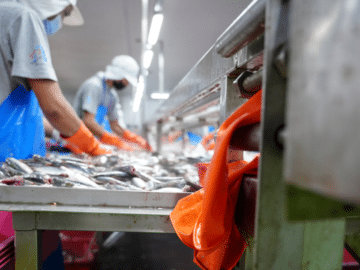
In the seafood sector, traceability is particularly significant. Seafood supply chains are recognized internationally as vulnerable to labour abuses, including forced labour, human trafficking, and other forms of worker exploitation. At the same time, seafood products often pass through multiple vessels, processors, traders, and countries before reaching consumers, making supply-chain transparency essential for effective oversight.
SeaChoice has long campaigned and continues to push for stronger laws and policies that would allow the government to identify and trace products through complex global supply chains. When products cannot be traced through the supply chain, authorities have limited ability to verify production conditions or determine whether forced labour was involved. Strengthening seafood traceability and import controls would provide regulators with better tools to assess supply-chain risks, support responsible businesses, improve consumer confidence, and enhance the implementation of existing laws intended to prevent products linked to forced labour from entering the Canadian market.
Following the release of the findings, the Canadian government responded and noted there would be upcoming amendments to the forced labour-related legislation. SeaChoice looks forward to engaging with these proposals when tabled.
SeaChoice leads global call to stop greenwashing extinction of prehistoric skate
SeaChoice member groups have been holding seafood eco-certifications, such as the Marine and Aquaculture Stewardship Councils, to account for over 20 years. Our expertise has resulted in us leading global collaborations with other conservation organisations to call out the greenwash and demand certifications live up to their promises.
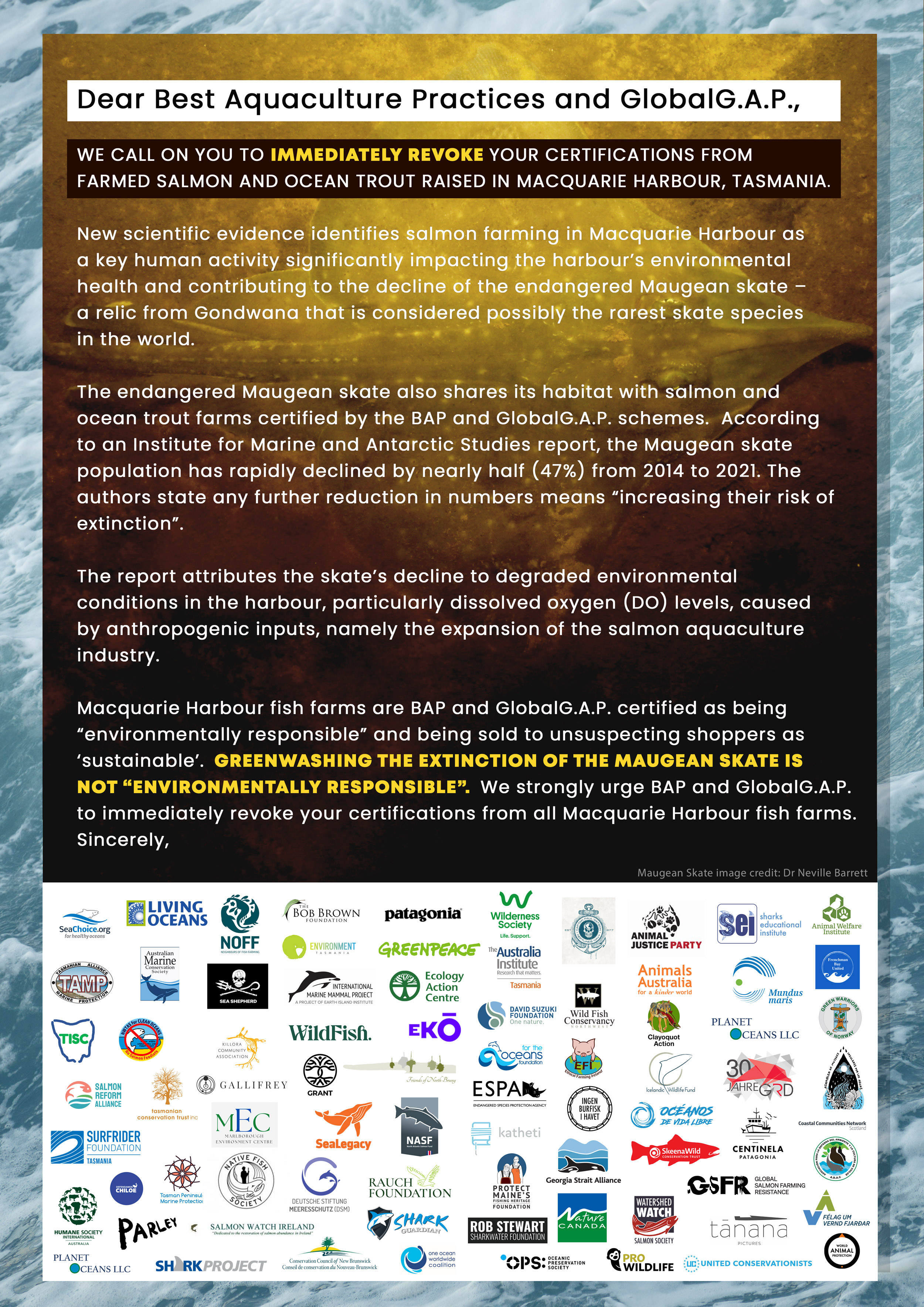
Most recently, Living Oceans helped rally over 80 organisations from around the world calling on the Best Aquaculture Practices and GLOBALG.A.P. schemes to immediately revoke their ‘sustainability’ certifications from salmon and ocean trout farms adjacent to the World Heritage Area, Macquarie Harbour, on the west coast of Tasmania.
Here’s the press release:
MORE THAN 80 GROUPS WORLDWIDE DEMAND FARMED SALMON ACCREDITATIONS STOP GREENWASHING THE EXTINCTION OF THE MAUGEAN SKATE
Shoppers being misled by eco-certifications on Macquarie Harbour farmed salmon
For immediate release 25th July 2023
More than 80 organisations from around the globe are calling for the accreditation schemes, Best Aquaculture Practices and GlobalG.A.P., to immediately revoke their ‘sustainability’ certifications from farmed salmon and trout raised in waters adjacent to the World Heritage Area, Macquarie Harbour, Tasmania.
The demand comes as federal and state government workshops are held in Hobart this week to decide on urgent action to prevent the extinction of the Maugean skate – a rare animal related to sharks and dating back to the time of dinosaurs.
Despite scientific evidence that industrial fish farms in Macquarie Harbour are having a major impact on the waterway’s health and skate numbers, all three salmon farming companies operating in the harbour are certified as “environmentally responsible” by BAP or GlobalG.A.P.
Signatories from 17 countries have sent open letters to both schemes demanding withdrawal of certification, condemning the misleading of unsuspecting shoppers, and calling for an end to greenwashing the extinction of the prehistoric skate.
The signatories include marine, shark conservation, animal welfare, and community groups, as well as independent scientists, a public policy think tank, and award-winning authors.
Found only in Macquarie Harbour, the endangered Maugean Skate is one of the listed natural values of the World Heritage Area.
Scientists from the University of Tasmania’s Institute of Marine and Antarctic Studies renewed their alarm recently after reporting a dramatic collapse in Maugean skate numbers with almost half disappearing in less than seven years.
The scientists attribute the Maugean skate’s decline to the degraded environmental conditions in the Harbour, particularly dissolved oxygen levels, and explicitly named fish farms as one of the main causes of low dissolved oxygen levels in Macquarie Harbour.
Quotes:
“Major supermarkets rely on these certifications to sell farmed salmon and ocean trout with their “responsibly sourced” logos as part of their sustainable seafood policies. But there is nothing responsible about driving one of the rarest skate species in the world to extinction.” – Kelly Roebuck, SeaChoice
“This is certified ecocide. The Maugean Skate has one critical habitat, one chance at survival, the science is there, and the urgent action that is required to save this animal is simply not happening. Instead, we have greenwashing.” – Jessica Coughlan, Neighbours of Fish Farms
“These certifications must not shirk their responsibility here. They cannot palm this off to the auditors or wait until the companies’ next audit to address this dire situation. Macquarie Harbour fish farm certifications should be immediately revoked, or they will be the first certification schemes in the world to certify an extinction of a species.” – Alistair Allan, Bob Brown Foundation
“Shoppers should be outraged to know that not only are they being misled by these certification claims, but they are unknowingly contributing to the demise of a species as old as the dinosaurs,” – Rebecca Howarth, Environment Tasmania
“The federal government is in Hobart again this week because the Tasmanian Government cannot be trusted to prevent the extinction of this species. Meanwhile, so-called ‘sustainability’ certification continues to greenwash the unsustainable practices of the salmon industry.” – Eloise Carr, Tasmanian Director, the Australia Institute
Make Stewardship Count, a coalition co-founded by SeaChoice, fears Marine Stewardship Council’s revised Fishery Standard doesn’t go far enough to protect marine life and ocean habitat.
Commonly recognized by its blue tick logo affixed to more than 20,000 products globally, the Marine Stewardship Council (MSC) is the world’s largest and most prominent seafood certification scheme, with over 400 fisheries across the globe certified under its standard. Make Stewardship Count is a coalition that engages with the Marine Stewardship Council to advance improvements in the certification and hasengaged significantly as a key stakeholder over the 5 year-long Fisheries Standard Review (FSR), implemented on May 1, 2023.
The MSC Fisheries Standard is meant to provide a framework within which the environmental impacts and effective management of a fishery can be assessed before it can use the MSC blue tick label. Consumers, retailers, and those working in the seafood industry must be able to trust that the label represents seafood caught sustainably and ethically. The Fisheries Standard Review provided MSC and stakeholders the opportunity to set the bar higher and drive real improvements in global fisheries.
Make Stewardship Count produced final scorecards based on a traffic light system to assess the final version of the standard against its list of critical asks andcall for transparency. The scorecards, ranking the elements of the revised Standard in mostly red and yellow, reflect that although there are some improvements, it falls below best practice in many other areas.
Early drafts of the new Standard generated optimism, as they included several of the improvements that SeaChoice and the coalition had been calling for throughout the review. While some of these improvements made it into the final version of the Standard, others were removed at the final critical stage of the review, with little explanation or opportunity for stakeholder input. Two such removed improvements include: marine mammal protection from fishing and science-based targets for observer coverage on board vessels. These would have been powerful requirements in the certification.
One of the strongest and most welcome improvements to the Standard, gaining one of the few ‘green’ scores from the coalition is the requirement for MSC fisheries to have a policy in place that sharks must be landed with their fins naturally attached to their bodies, a globally recognized best practice.
Throughout the review process, the coalition challenged MSC to strengthen its requirements for the protection of Endangered, Threatened and Protected (ETP) species and is pleased that MSC focused on designing a significantly improved ETP species designation process. However, the new Standard allows species designated as ETP to be considered eligible for certification as an MSC product by introducing ‘modification factors’. These factors risk undermining designation improvements and are not precautious enough. The coalition worries that this will allow economically valuable ETP species to become MSC certified, despite not being well managed or recovering.
It is impossible to know how and if changes to the Standard will truly impact certifications until they are applied to fisheries over the next several years. Ultimately, the coalition is concerned that the new Standard, which will be in place for at least the next decade, will continue to be awarded to fisheries that routinely catch vulnerable animals, waste excessive amounts of sea life, damage ecosystems and catch overfished species.
Visit the Make Stewardship Count website to learn about their final scorecard on the Standard contents, the Review process andmore details about the new V3.0 MSC Fisheries Standard.
Stronger traceability will help curtail unsustainable practices, fraud, human rights abuses and illegal fishing.
In December, SeaChoice along with 25 seafood companies, grocery store chains and experts called on the Federal government to bring Canada’s seafood traceability standards into the 21st century.
The letter, delivered to the Canadian Food Inspection Agency as part of its recent boat-to-plate seafood traceability consultation, argues that the minimum standards for traceability be expanded so that all seafood products sold in Canada are fully traceable from the point of final sale back to the point of harvest, including key information about the who, what, where, when and how of fishing or farming, processing and distribution. The signatories, including the large grocery store chains Buy-Low Foods and Save-On-Foods, and large seafood supplier, Ocean Brands, also emphasized their concern that no timeline or plan is in place for the implementation of a better traceability system.
Government action on this promise is long-awaited, as the commitment was made initially in 2019 when the Federal government instructed the Canadian Food Inspection Agency to work with the Minister of Fisheries, Oceans and the Canadian Coast Guard and the Minister of Agriculture and Agri-Food, to develop a boat-to-plate traceability program to help Canadian fishers to “better market their high-quality products”.
However, the instruction to deliver this program is missing from the new mandate letters published in December 2021, meaning continued support for improved seafood traceability from industry, experts, and the public is critical to ensure progress at the Federal level.
With jurisdictions worldwide increasingly requiring electronic data to follow seafood products through the supply chain to safeguard their true identity and point of origin and to ensure legality, Canada needs to step up and implement a boat-to-plate traceability system, for all seafood sold in Canada.
What’s next?
On December 11th, 2021 the Canadian Food Inspection Agency closed its 120-day consultation period on the boat-to-plate traceability program. The Agency will be reviewing the feedback received and publishing a “What We Heard” report summarizing the submissions and feedback this spring/summer.
The House of Commons Standing Committee on Fisheries and Oceans is currently studying seafood traceability in Canada as a way to support the sustainability and long-term viability of Canada’s seafood supply chains and will present their recommendations to the government.
SeaChoice will continue to engage with the government and industry to ensure the implementation of a modern, full-chain seafood traceability system that is long overdue in Canada. Sign up for our newsletter to be kept informed of developments and opportunities for you to show your support for seafood traceability and labelling.
Many issues the Netflix film covers hit home, but details and the proposed solution miss the mark.
Seaspiracy, a Netflix film about our impact on the oceans, has people talking. Prominent marine conservation organizations and fisheries scientists have highlighted its misrepresentation of scientific facts and contested its main message (for example, here and here) — that there’s no way to produce seafood sustainably so people should stop eating it.
Commentators have also noted the film’s:
Failure to acknowledge the need for and benefits of small-scale and artisanal fisheries
Colonial overtones
Lack of positive representation from the global South
Misrepresentation of non-governmental organizations (NGOs) and their staff
Omission that there are 177 NGOs working on a global campaign to eliminate harmful fishing subsidies
Implication that three billion people switching to land-based protein wouldn’t have an environmental impact
I knew I’d find the film upsetting. After over a decade working in fisheries and marine conservation, I’m more familiar than I’d like to be with whaling, shark finning, overfishing, destructive fishing practices, bycatch of marine animals, plastic pollution and human rights abuses.
Watching the film, I agreed with its points about the interconnection between marine ecosystem health and human health; the challenges of controlling and policing vessels on the high seas, thousands of miles from the nearest coast; the interplay between economics and environmental degradation.
However, I don’t agree that everyone should stop eating seafood — because this won’t stop the atrocities in the film from happening. And not all fishing is conducted the way the film represents. For example, in many Canadian fisheries, fleets of small boats operate in well-managed, tightly controlled fisheries.
For millions of people worldwide, not eating seafood is not an option — it’s their primary source of protein and/or employment. Millions in richer countries have their choice of protein options but — as awful as many of the film’s scenes are — few will stop eating seafood, even if they feel guilty about it. As the environmental community has learned over decades of trying to elicit behaviour change, telling people about their negative impacts seldom works, especially for things that require significant lifestyle change, like giving up flying or eating meat.
My hope is that people who watch this film come away with a better understanding of why our food choices matter. If you want to stop eating seafood, or all meat, that’s a valid choice. If you decide to continue eating seafood, Seaspiracy shows some of the risks. But you can substantially lower your risk of contributing to those problems:
Find out how and where seafood products are harvested. Canada’s weak seafood labelling laws make this challenging, but asking for more information is essential if you want to use sustainability guides like those from Ocean Wise or Seafood Watch that assess and score the sustainability of hundreds of seafood types.
Buy seafood with a reputable eco-label. The Marine Stewardship Council, while not perfect, is driving positive change. Products carrying their label are more likely to be responsibly produced than those without. The same goes for the Aquaculture Stewardship Council and Best Aquaculture Practice labels. This article underlines labelling practices to be cautious of.
Support businesses following best practices, including labelling and traceability. You can buy Canadian-produced, sustainable, traceable seafood. Check out Skipper Otto, Organic Ocean and Afishionado.
Tell your retailer you care about sustainable seafood. Every major retailer in Canada has committed to sourcing (at least some) sustainable seafood, but practices vary in scope and ambition. Seafood Progress shows your retailer’s commitment and what steps it’s taking to improve seafood production. Tweet retailers from their profile pages, talk to seafood counter staff or call customer service lines.
Eat low on the food chain. Farmed mussels, clams and oysters benefit ecosystems because they require no or few inputs and feed by filtering water.
Learn more. Ian Urbina’s The Outlaw Ocean covers many of Seaspiracy’s themes but doesn’t gloss over the nuance, the human stories and the real reasons the ocean is threatened. Or read Urbina’s series on ocean crimes in the New York Times.
Given what I know about the seafood industry, I can be a pain for friends or family when we go for sushi. If they watch Seaspiracy, next time they might understand. I’ll continue eating seafood but only if there’s enough information for me to know a product was responsibly produced. This helps support forward-thinking, responsible seafood businesses trying to do the right thing and encourages others to invest in better practices.
Now tell Canada to step up and better regulate GM salmon to protect both wild fish and consumers
The farmed salmon in your grocer’s seafood case is most likely from an open net-pen located in Canada, Norway, Iceland or Chile. That’s because only a small amount of more responsibly farmed salmon from land-based closed containment facilities currently enters the Canadian marketplace. The situation is about to change, with nearly one million metric tonnes of land-based production scheduled to enter the marketplace over the next few years and we welcome that change – for the most part. But some of that land-based salmon will be genetically modified; and it won’t be labelled as such.
AquaBounty™ farmed salmon is now being produced in both Canada and the US and is approved for human consumption in both places. Despite the efforts of Canadian civil society groups, our courts declined to overturn the approval of GM salmon on environmental grounds. However, courts in the US recently adopted a different approach.
In response to a petition filed by SeaChoice partner organization, Ecology Action Centre, and others, a California court recently ruled that the Food and Drug Administration (FDA) ignored the serious environmental consequences of approving GM salmon and the full extent of plans to grow and commercialize the salmon in the U.S. and around the world, violating the National Environmental Policy Act. The Court also ruled that FDA’s unilateral decision that GM salmon could have no possible effect on highly endangered wild Atlantic salmon was wrong, violating the Endangered Species Act.
This decision will ensure that U.S. legislation and policy for environmental and species protection is followed when future applications come forward for genetically modified food animals and in that sense, it is a huge victory. However, the FDA can address these procedural errors by conducting the appropriate environmental review – something it is sure to do now that AquaBounty has set up shop in the US, as well as Canada.
Both Canadian and U.S. regulators identified the potential high risk to wild Atlantic salmon should the GM salmon escape to the wild. Competition for food and habitat, predation and transmission of disease represent clear threats to severely depleted stocks of wild salmon; and a small proportion of the GM stock will also be capable of interbreeding, polluting the genetic integrity of wild Atlantic salmon. Nevertheless, both regulators decided that closed containment facilities were a whole answer to this risk, failing to assess the implications of accidental releases due to human or mechanical error.
The approval of GM salmon is a classic example of permitting what is possible, without any public dialogue on what is wise or desirable. The fact remains that the farming of salmon represents a net loss of fish suitable for human consumption: it does not relieve world hunger or contribute to food security. It doesn’t even reduce fishing pressure on wild fish, because the market for salmon is growing so rapidly worldwide, driven largely by the massive production of farmed salmon. The genetic modification of the fish to grow faster only exacerbates the pressure on the forage fisheries that supply the fish meal and fish oil required to produce carnivorous fish.
Industry might argue that the marketplace determines what is wise or desirable, but this particular product is being passed off as the same as any other salmon: it doesn’t have to be labelled as genetically modified. The marketplace has nothing to say about GM salmon because they’re invisible to all but the most determined and discerning consumers, who demand to know the source of the fish they buy.
In Canada, we need to take further action to ensure that we and wild salmon are safeguarded from the GM salmon being produced here. In October, a petition was launched in the House of Commons to enhance regulations for the production of GM food animals, improve consumer protection (so you can know when you’re eating GM salmon!) and harmonize legislation with the United Nations Declaration on the Rights of Indigenous Peoples. Take action today: this petition closes January 13, 2021!
You’ve heard the old saying – if it sounds too good to be true, it probably is.
Case in point: Last month, Cooke Aquaculture, one of the largest salmon farming companies in the world, proclaimed in its press release and social media posts “True North Seafood officially recommended as sustainable by Ocean Wise”. Some media outlets have amplified the misrepresentation. So, let’s set the record straight.
Contrary to Cooke’s statement, only a part of the True North Seafood brand and associated products are endorsed by Ocean Wise.
Stating that the True North Seafood brand is “recommended as sustainable” by the Ocean Wise program could mislead unsuspecting shoppers to assume all of their seafood, including the brand’s net-pen farmed Atlantic salmon, is Ocean Wise endorsed. When in fact, it is not.
Why does this matter? Large corporations overreaching their green credentials is, unfortunately, nothing new. However, the negative ramifications from misleading green claims can be far reaching.
As outlined in our recently released study,Certification, Verification or Fabrication? An investigation of seafood environmental claims in Canadian retailers, misleading claims can lead to consumer confusion and skepticism towards all environmental claims. At worst, they have the potential to undermine efforts aimed at improving fishery and aquaculture sustainability.
A YouGov poll conducted simultaneously with our study found that 83% of Canadians are “somewhat to very concerned” about greenwashing and that 78% of Canadians who purchase seafood would likely stop purchasing a seafood product if its claim were found to be greenwashing.
There’s no hiding that Cooke Aquaculture has had some not-so-green practices. For example, the company was fined by Washington State for violations associated with the 2017 collapse of their Cypress Island net pen farm that released 250,000 farmed salmon escapees into Puget Sound. Their Kelly Cove division was charged and pleaded guilty to illegal pesticide use that was connected with the deaths of hundreds of lobsters in the Bay of Fundy in 2009. Overly simplified public relation assertions won’t erase these track records.
The Ocean Wise program works with its partners to encourage improvements in their sustainability practices and procurement. SeaChoice sincerely hopes positive gains for our oceans are made through the partnership.
But we call on Cooke to represent the partnership truthfully and accurately. That is, that the partnership does not mean the True North brand (or Cooke) is recommended as Ocean Wise, but rather that some of Cooke’s True North branded products are Ocean Wise recommended. In turn, these recommended products should be clearly labelled Ocean Wise on the True North website and on product packages.
Because at the end of the day, we should be able to trust any claims that are made on the products we buy. Environmental claims and eco-labels are meant to make shopping for sustainable seafood easier, not harder.
Seafood companies should provide proof to back up their claims
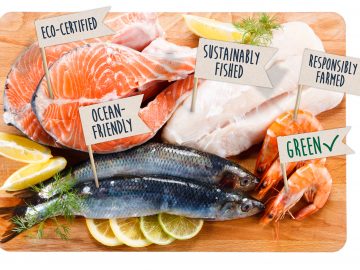
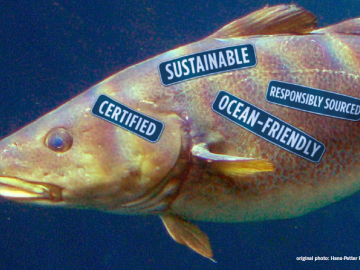
“Sustainable”. “Ocean-friendly”. “Responsible”. From canned tuna to frozen fish sticks, these “green” claims seem to be slapped on every kind of seafood product in our grocery stores these days. But what do they mean? And better still, can we count on them to deliver on their promises? SeaChoice decided to find out. Spoiler alert: some are fishier than others. Read on to find out which.
“Green” or environmental claims – logos and written statements – are supposed to help take the guesswork out of the selection process for shoppers who want to make ocean-friendly seafood purchases. When done right, claims represent a mechanism through which seafood consumers can ‘vote with their wallets’ and improve fishery and aquaculture practices by doing so. But greenwashing, the practice of making a misleading or unsubstantiated claim, can undermine this influence by fooling well-intentioned shoppers and shifting consumer preferences toward products that are not environmentally beneficial and/or creating an unwarranted favourable image of a company.
We know that Canadians care about greenwashing. A YouGov poll conducted simultaneously with our investigation found that 83% of Canadians are concerned about greenwashing and 78% would likely stop purchasing a seafood product if its claim was found to be greenwashing.
So, is there a warranted concern that greenwashing is taking place in Canadian supermarket fresh cases, aisles and freezers?
It’s important to understand that not all environmental claims are created equal. Some claims can be independent, such as third-party certifications (e.g., MSC, ASC and BAP) or non-governmental endorsements (e.g., Ocean Wise), or private company self-declarations. We categorized the claims into three types: certifications, endorsements, and self-declared claims. The different types of claims vary in their scope, accuracy, transparency and rigour. They also vary in their interpretation of “sustainability” as there are no regulations that strictly define the term for seafood (or any other commodity) sold in Canada.
First, we documented the prevalence of each environmental claim type and found self-declared claims – those made only by the brand, without any third-party backing – were the most common (44% of all claims). The rest were 33% endorsements and 23% certifications.
Next, we checked whether the claims were backed up by publicly available evidence (i.e., the product label or website) and investigated whether the claim on the product could be verified to be from environmentally friendly fisheries or farms. Forty per cent of self-declarations failed to provide evidence and around six out of every ten self-declared claims were unverifiable. In comparison certifications, followed by endorsements, were found to be far more reliable.
Finally, we compared self-declared claims against international best practice guidelines for environmental claims. Eight out of every ten self-declared claims were found to be vague and non-specific, over a third failed to provide an explanatory statement with the claim and nearly a quarter used the term “sustainable” (or a variation thereof) despite the recommendation by guidelines not to do so.
In summary, the most frequently found environmental claim type in Canadian supermarkets, self-declarations by companies, were the hardest to verify, typically lacked evidence and were often vague. Why would this be so? Self-declared claims rarely involve independent checks. In comparison, certifications generally have four common features: governance structures, standards for sustainability and chain-of-custody, an auditing function, and on-product logos. Self-declared claims typically lack the first three.
SeaChoice is calling on the government to enact stronger requirements for self-declared claims, particularly for the use of the words “sustainable” and “responsible”, by stipulating that a third-party verification is the only acceptable evidence to support their use. Our investigation findings also support SeaChoice’s push for better seafood labelling laws, as having these would help substantiate the environmental credentials of a given product.
What about conscientious shoppers just looking to buy some seafood for dinner that won’t harm the oceans? Based on our findings, your best bets are certified products, complementing these with endorsed products as needed. Regardless of the claim type, but particularly when purchasing self-declared products, look for evidence to back up the claim on the product or website. In fact, 90% of you agree that companies should provide publicly available information to back up their claims. So, tell your retailer and the seafood companies whose products are sold within their stores that you expect this evidence to be provided.
Lastly, If a product with an environmental claim lacks evidence to back it up, or if you suspect the claim may be a deceptive representation of the product (i.e., greenwashing), contact the Canadian Food Inspection Agency toreport a food labelling concern. Because at the end of the day, fishy claims shouldn’t have a place in our grocery aisles and freezers.
When a company makes a commitment, customers expect them to follow through
This year’s global pandemic has highlighted the importance that grocery stores play in our lives. As we start to look towards recovery, focusing on sustainable and responsible business practices is essential to protect vulnerable people, ecosystems, and consumer trust. But when it comes to seafood sustainability, Seafood Progress shows that most Canadian retailers have made limited progress in the past year.
This is the third year that SeaChoice has worked with Canada’s eight largest retailers to assess their sustainable seafood commitments and their actions against those commitments. From July 2019 to now, we have no evidence of any improvements by Costco Canada or Save-On-Foods.
Figure 1: Retailers’ scores on Key Performance Indicator 3.2 (each line represents one retailer’s score)
However, there are some bright spots – two more retailers are now being transparent about the progress they are making against their sustainable seafood commitment. In the past year, both Sobeys and Walmart Canada announced how much of their fresh and frozen seafood sold in the past year met their commitment (see Figure 1). This is a big step forward because a retailer’s impact on sustainable seafood production is only as good as its actual practices. As the saying goes, actions speak louder than words. Now all of Canada’s major retailers, except Costco, are actively participating in Seafood Progress and disclosing performance against their commitment.
Other notable improvements include Federated Cooperatives Limited’s (“Co-op”) decision to start labelling all of its fresh and frozen seafood products with scientific name, geographic origin, method of production and whether it’s farmed or wild – information that is essential for consumers who want to know what they’re eating and where it came from. METRO, which already has the traceability and labelling in place to support that level of detail for its fresh, frozen and shelf stable products (like canned tuna, tins of anchovies or jars of clams), recently expanded its traceability requirements to all of its sushi suppliers.
For the first time this year, SeaChoice examined how much of a retailer’s seafood is covered by its sustainable seafood commitment. For some retailers, it’s much less than you might think.
Figure 2: How many retailers include which segments under the scope of their seafood commitment or policy.
We found that most retailers’ commitments focus on fresh and frozen products from their own grocery store brands, leaving out large volumes of shelf stable seafood and products from well-known seafood company brands such as Birds Eye, High Liner or Clover Leaf. So, if you’re one of the many people who stocked up on canned tuna during the past few months, there’s a good chance this wasn’t sourced in line with the retailers’ seafood commitment since only two out of eight retailers’ commitments include all shelf stable seafood products.
SeaChoice is encouraging retailers to increase the scope of their commitments so that all of the seafood products they sell, in all of their stores, are being sourced responsibly – not just those that are easiest or most convenient. Because seafood harvested by way of unsustainable fishing practices and potential human rights abuses has no place in Canadian grocery stores.
You can help make that happen by visiting SeafoodProgress.org to see what your retailer is doing to support sustainable seafood. Tweeting your retailer or speaking with a store associate or customer service representative is another good way to show that you care about what they’re doing – or not doing.