VANCOUVER / UNCEDED xʷməθkʷəy̓əm (MUSQUEAM), Sḵwx̱wú7mesh (SQUAMISH), AND səlilwətaɬ (TSLEIL-WAUTUTH) TERRITORIES — The Federal Court of Appeal today issued a decision on an appeal by MOWI against then Fisheries Minister Joyce Murray’s decision to keep salmon farms in the Discovery Islands shuttered. Farms have been closed there since early 2021, when licence extensions were first denied. Minister Murray made an express finding that science required that she make a precautionary decision about the licences and today’s decision confirms that choice.
The Federal Court decision under appeal also confirmed the Minister’s ability to refuse aquaculture licenses based on conservation concerns. Ecojustice represented Living Oceans Society and colleagues the David Suzuki Foundation, Georgia Strait Alliance, Watershed Watch Salmon Society, and independent biologist Alexandra Morton in the case.
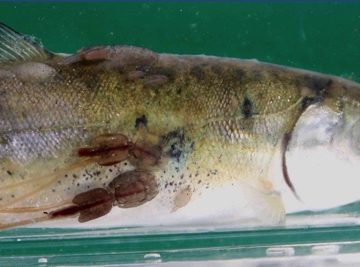
The Discovery Islands are a critical migration route for Fraser River sockeye and other salmon populations. Research shows that fish farms in these waters expose wild salmon to parasites and diseases, which was a contributing factor to steep population declines. Since farms have been removed from Sechelt, the Discovery Islands and the Broughton Archipelago, the Salmon Coast Field Station has reported healthier-looking juvenile salmon with fewer salmon lice each year. Returns of adult salmon have increased as well, with this year’s Fraser River sockeye returns outperforming the forecast by over 400 per cent.
“We all owe a debt of gratitude to these Ministers who stood firm in showing the Department of Fisheries what precautionary decision-making looks like,” said Karen Wristen, Executive Director at Living Oceans Society. “Departmental advice was to re-issue the Discovery Islands licences but both Ministers took the time to hear from independent scientists who have published extensively on the harm caused by salmon farms.”
The government has promised to end open-net fish farming across B.C. by 2029, but has yet to deliver the long-awaited Salmon Aquaculture Transition Plan or to define what technology will be permitted for use after the ban takes effect.
New report finds major seafood seller T&T Supermarket is not covered by Loblaw’s Sustainable Sourcing Guide for Seafood, despite mounting evidence of abuse in global seafood supply chains.
SeaChoice has profiled Loblaw annually against its seafood policies and practices since 2018 on Seafood Progress alongside other major Canadian retailers. Disappointingly, Loblaw relayed again to SeaChoice in this year’s report that it has no plans to include T&T under its Sustainable Sourcing Guide for Seafood.
In past Seafood Progress assessments we have explored the nature and supporting elements of retailer policies (do they have timebound goals, full chain traceability, etc). However, we have found that even the most robust policies are limited in scope. This is often not well communicated as retailers market their policies in a way that suggests they apply to everything and downplay which stores and products are excluded. What’s more, retailers remain quiet as investigations tying unethical seafood to their shelves pile up. To shine a spotlight on this issue, SeaChoice’s latest report takes a closer look at which seafood products and stores retailers’ ethical sourcing policies actually apply to, and which they avoid responsibility for.
Following a global theme, our report shows Canadian retailers’ exclude nearly half their seafood products and store chains from their ethical sourcing policies.
T&T Supermarket (T&T) is a growing North American chain where seafood is a major offering. T&T was acquired by Loblaw Co in 2009 for $225 million, and in the same year, the chain’s annual revenue exceeded $500 million. There are currently 37 T&T stores across Canada, and the first store opened in the United States in the fourth quarter of 2024. Loblaw recently announced plans to open 80 new stores in Canada in 2025 under various store banners, including T&T.
To shed light on the significance of Loblaw excluding T&T from its Sustainable Seafood Guide, SeaChoice conducted an in-store audit.
Our analysis found: there’s plenty of fish in the T&T sea.
The store more than lives up to its promise of being ‘Langley’s Seafood Destination.’ We photographed around 250 seafood products – the majority of which are imported – across various categories including shelf stable, fresh, frozen, beauty and health products.
The store has significant infrastructure to house its seafood, including:
1 x dedicated seafood counter (approximately 500 square feet) containing fresh and live seafood.
5 x approximately 300 square foot freezer cases full of frozen seafood.
6 x stand-up cases (approximately) full of fresh and frozen seafood.
1 x dedicated sushi counter (approximately 20-feet long).
4 x approximately 40-foot aisles full of shelf stable seafood products (cans, bags, jars, bottles, pouches, jugs, etc).
1 x dedicated display case for fish oil capsules in the health section.
In this year’s Seafood Progress report, Loblaw did not respond when asked if it plans to strengthen efforts to ensure that its seafood suppliers comply with its ethical sourcing policies, amid growing evidence of forced labour, illegal fishing, etc. in global seafood supply chains. For instance, Loblaw was directly implicated in The Outlaw Ocean Project’s China series where egregious human rights and environmental abuses were connected back to seafood products sold by North American retailers. As evidence of its global significance, China’s seafood industry accounts for a fifth of international seafood trade, is worth over thirty-five billion dollars and is responsible for catching approximately 5 billion pounds of seafood annually.
Beyond Loblaw’s initial correspondence with Outlaw Ocean (published here), the retailer has not reported on its efforts to remediate based on the findings of that investigation.
A supplier of Loblaw’s private label seafood, Premier Marine Canada, was also implicated in the China series (correspondence here), as were various third-party seafood brands that are commonly sold by Loblaw (e.g., Aqua Star, High Liner and Toppits).
Since Canada requires little controls for sustainability or human rights on imports, the more imported seafood retailers sell the higher the risk of unethical products making their way to store shelves. Therefore, it is even more important for Loblaw to apply its ethical sourcing policies to T&T as a chain that offers significant volumes of imported seafood. With due diligence legislation gaining momentum, and voluntary certifications and social audits failing to detect abuse, it’s time retailers – including Loblaw – proactively implement a due diligence approach to sourcing all seafood products.
SeaChoice leads global call to stop greenwashing extinction of prehistoric skate
SeaChoice member groups have been holding seafood eco-certifications, such as the Marine and Aquaculture Stewardship Councils, to account for over 20 years. Our expertise has resulted in us leading global collaborations with other conservation organisations to call out the greenwash and demand certifications live up to their promises.
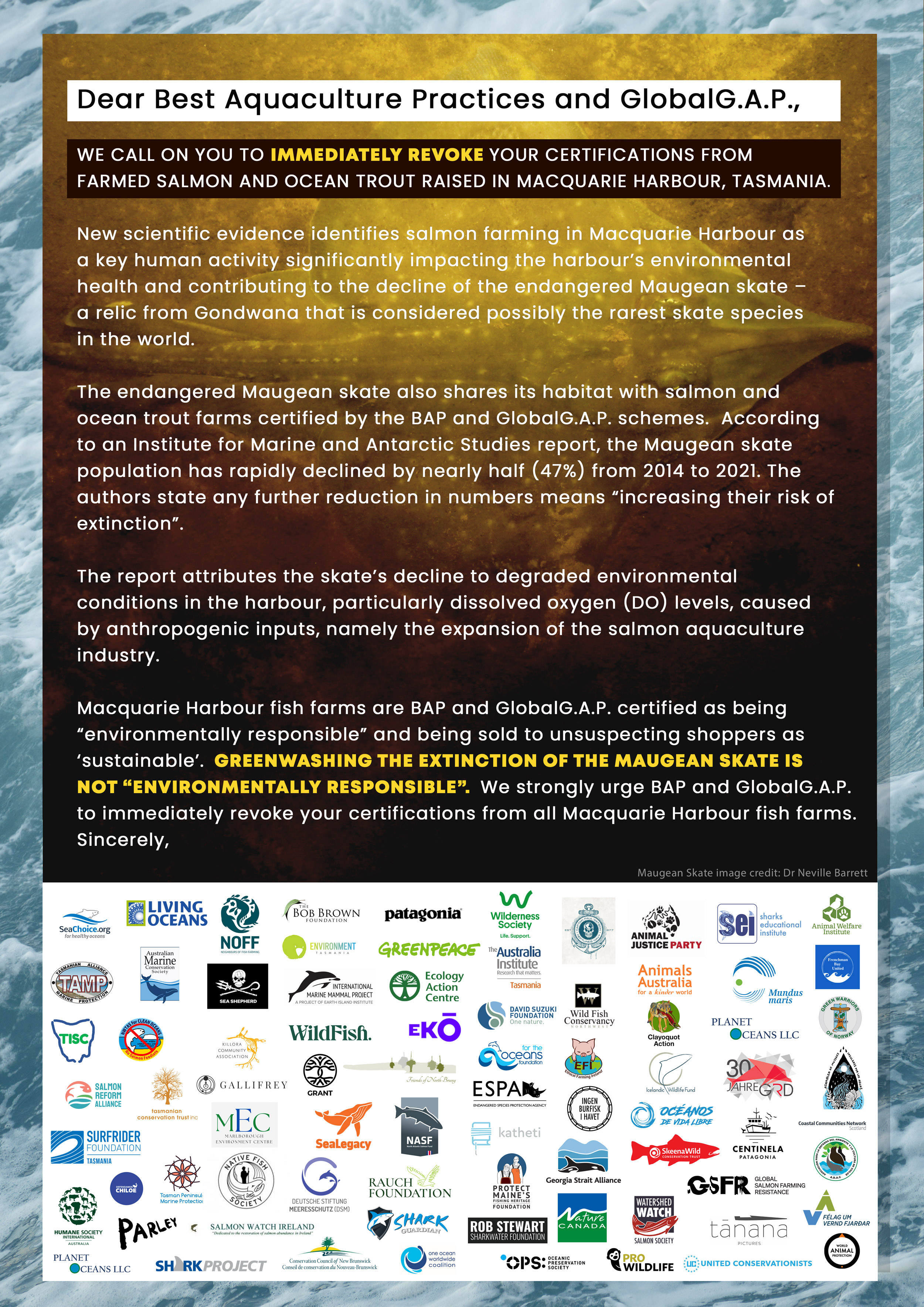
Most recently, Living Oceans helped rally over 80 organisations from around the world calling on the Best Aquaculture Practices and GLOBALG.A.P. schemes to immediately revoke their ‘sustainability’ certifications from salmon and ocean trout farms adjacent to the World Heritage Area, Macquarie Harbour, on the west coast of Tasmania.
Here’s the press release:
MORE THAN 80 GROUPS WORLDWIDE DEMAND FARMED SALMON ACCREDITATIONS STOP GREENWASHING THE EXTINCTION OF THE MAUGEAN SKATE
Shoppers being misled by eco-certifications on Macquarie Harbour farmed salmon
For immediate release 25th July 2023
More than 80 organisations from around the globe are calling for the accreditation schemes, Best Aquaculture Practices and GlobalG.A.P., to immediately revoke their ‘sustainability’ certifications from farmed salmon and trout raised in waters adjacent to the World Heritage Area, Macquarie Harbour, Tasmania.
The demand comes as federal and state government workshops are held in Hobart this week to decide on urgent action to prevent the extinction of the Maugean skate – a rare animal related to sharks and dating back to the time of dinosaurs.
Despite scientific evidence that industrial fish farms in Macquarie Harbour are having a major impact on the waterway’s health and skate numbers, all three salmon farming companies operating in the harbour are certified as “environmentally responsible” by BAP or GlobalG.A.P.
Signatories from 17 countries have sent open letters to both schemes demanding withdrawal of certification, condemning the misleading of unsuspecting shoppers, and calling for an end to greenwashing the extinction of the prehistoric skate.
The signatories include marine, shark conservation, animal welfare, and community groups, as well as independent scientists, a public policy think tank, and award-winning authors.
Found only in Macquarie Harbour, the endangered Maugean Skate is one of the listed natural values of the World Heritage Area.
Scientists from the University of Tasmania’s Institute of Marine and Antarctic Studies renewed their alarm recently after reporting a dramatic collapse in Maugean skate numbers with almost half disappearing in less than seven years.
The scientists attribute the Maugean skate’s decline to the degraded environmental conditions in the Harbour, particularly dissolved oxygen levels, and explicitly named fish farms as one of the main causes of low dissolved oxygen levels in Macquarie Harbour.
Quotes:
“Major supermarkets rely on these certifications to sell farmed salmon and ocean trout with their “responsibly sourced” logos as part of their sustainable seafood policies. But there is nothing responsible about driving one of the rarest skate species in the world to extinction.” – Kelly Roebuck, SeaChoice
“This is certified ecocide. The Maugean Skate has one critical habitat, one chance at survival, the science is there, and the urgent action that is required to save this animal is simply not happening. Instead, we have greenwashing.” – Jessica Coughlan, Neighbours of Fish Farms
“These certifications must not shirk their responsibility here. They cannot palm this off to the auditors or wait until the companies’ next audit to address this dire situation. Macquarie Harbour fish farm certifications should be immediately revoked, or they will be the first certification schemes in the world to certify an extinction of a species.” – Alistair Allan, Bob Brown Foundation
“Shoppers should be outraged to know that not only are they being misled by these certification claims, but they are unknowingly contributing to the demise of a species as old as the dinosaurs,” – Rebecca Howarth, Environment Tasmania
“The federal government is in Hobart again this week because the Tasmanian Government cannot be trusted to prevent the extinction of this species. Meanwhile, so-called ‘sustainability’ certification continues to greenwash the unsustainable practices of the salmon industry.” – Eloise Carr, Tasmanian Director, the Australia Institute
Make Stewardship Count, a coalition co-founded by SeaChoice, fears Marine Stewardship Council’s revised Fishery Standard doesn’t go far enough to protect marine life and ocean habitat.
Commonly recognized by its blue tick logo affixed to more than 20,000 products globally, the Marine Stewardship Council (MSC) is the world’s largest and most prominent seafood certification scheme, with over 400 fisheries across the globe certified under its standard. Make Stewardship Count is a coalition that engages with the Marine Stewardship Council to advance improvements in the certification and hasengaged significantly as a key stakeholder over the 5 year-long Fisheries Standard Review (FSR), implemented on May 1, 2023.
The MSC Fisheries Standard is meant to provide a framework within which the environmental impacts and effective management of a fishery can be assessed before it can use the MSC blue tick label. Consumers, retailers, and those working in the seafood industry must be able to trust that the label represents seafood caught sustainably and ethically. The Fisheries Standard Review provided MSC and stakeholders the opportunity to set the bar higher and drive real improvements in global fisheries.
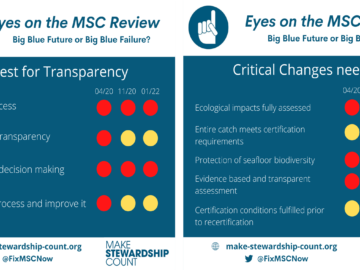
Make Stewardship Count produced final scorecards based on a traffic light system to assess the final version of the standard against its list of critical asks andcall for transparency. The scorecards, ranking the elements of the revised Standard in mostly red and yellow, reflect that although there are some improvements, it falls below best practice in many other areas.
Early drafts of the new Standard generated optimism, as they included several of the improvements that SeaChoice and the coalition had been calling for throughout the review. While some of these improvements made it into the final version of the Standard, others were removed at the final critical stage of the review, with little explanation or opportunity for stakeholder input. Two such removed improvements include: marine mammal protection from fishing and science-based targets for observer coverage on board vessels. These would have been powerful requirements in the certification.
One of the strongest and most welcome improvements to the Standard, gaining one of the few ‘green’ scores from the coalition is the requirement for MSC fisheries to have a policy in place that sharks must be landed with their fins naturally attached to their bodies, a globally recognized best practice.
Throughout the review process, the coalition challenged MSC to strengthen its requirements for the protection of Endangered, Threatened and Protected (ETP) species and is pleased that MSC focused on designing a significantly improved ETP species designation process. However, the new Standard allows species designated as ETP to be considered eligible for certification as an MSC product by introducing ‘modification factors’. These factors risk undermining designation improvements and are not precautious enough. The coalition worries that this will allow economically valuable ETP species to become MSC certified, despite not being well managed or recovering.
It is impossible to know how and if changes to the Standard will truly impact certifications until they are applied to fisheries over the next several years. Ultimately, the coalition is concerned that the new Standard, which will be in place for at least the next decade, will continue to be awarded to fisheries that routinely catch vulnerable animals, waste excessive amounts of sea life, damage ecosystems and catch overfished species.
Visit the Make Stewardship Count website to learn about their final scorecard on the Standard contents, the Review process andmore details about the new V3.0 MSC Fisheries Standard.
SeaChoice activated consumers to send over 2,000 emails to grocers and seafood brands in just three months, demanding they do more on sustainable and socially responsible seafood.
Seafood Progress — an initiative introduced by SeaChoice five years ago to help drive accountability and transparency in seafood supply chains — has evolved significantly over the past year. Last year, SeafoodProgress.org expanded beyond grocers to include major seafood brands. SeaChoice shared the first-year results for brands with the public in May, followed by the fifth-year results for grocers in June.
In tandem with this release, SeaChoice introduced a feature that allowed viewers to send custom emails directly from their profile pages to retailers and brands.
Unsurprisingly, 67 per cent of the messages sent called on major seafood brands and grocers to disclose more information on their product labels.
This outcome indicates that consumers are increasingly frustrated by haphazard labelling of seafood products due to Canada’s weak regulatory requirements. This finding is consistent with SeaChoice’s polling results from November 2021, which found Canadians want stronger requirements and more information. However, SeaChoice’s 2022 Seafood Progress results reveal that, across the board, grocers are applying just over half the information they should to their seafood labels, and brands apply less than one-third.
In other words….
Most of the seafood consumers buy is not being labelled with critical information, such as whether it is wild or farmed and where it was actually caught or farmed!
On a positive note, SeaChoice commends METRO for being the only grocer to receive a perfect score for its best practice labelling every year since 2018, and Rio Mare for being the only brand to have published a time-bound commitment to achieve best practice labelling by 2024.
Consumers also advocated for more action to protect the people in seafood supply chains.
Over a quarter of the messages sent to grocers and seafood brands called out their weak commitments to protect the people in their seafood supply chains, as well as their lack of progress against commitments. The average score across all grocers in this area actually declined from 61 per cent in 2018 to 58 per cent in 2022. Additionally, the average score for brands in 2022 was disappointingly low at 35 per cent.
SeaChoice expects brands and grocers to pay close attention to the messages sent to them by consumers, and hopes to see their reactions reflected in 2023 profile scores. Human rights abuses and poor practices at sea, on aquaculture farms and in processing plants continue to be reported. Grocers and brands have a responsibility to actively investigate their supply chains for such atrocities and remediate them to drive improvements upstream.
If you didn’t get a chance to send your grocer or brand a message, you still can! Visit SeafoodProgress.org, select a brand or grocer, and click the orange “TAKE ACTION” button on their profile page.
SeaChoice intends to run these email campaigns again in 2023 to encourage continued progress among brands and retailers and to raise awareness among consumers.
Global coalition of experts, Make Stewardship Count, concerned that long-awaited changes to fisheries eco-label won’t go far enough.
The Marine Stewardship Council (MSC) is the world’s largest and most prominent seafood certification scheme, with over 400 fisheries across the globe certified under its standard. MSC states that its vision is of “the world’s oceans teeming with life”, but what role will it play to move toward this vision? Consumers, retailers and those working in the seafood industry must be able to trust the labels on seafood products.
Due to its outsized influence on the sustainable seafood marketplace and global definitions of sustainable fishing, SeaChoice has worked for many years with MSC and others in the conservation community to keep the eco-label rigorous and to ensure fisheries getting their stamp of approval really are the best of the best.
Unfortunately our in-depth analysis, What’s behind the label?, released in 2017, showed that MSC was no longer living up to its claims or driving best practice. After years of engaging with the assessment of each Canadian fishery that sought MSC certification and leaving frustrated with the process, our report highlighted the need for SeaChoice to instead focus on improving the MSC Certification Standard itself – the definition of sustainable fishing and the scoring by which fisheries are assessed to become an MSC certified fishery.
We have spent years now engaging with the MSC at every opportunity to improve the Standard and finally, a revised MSC Certification Standard will be revealed on February 1st, 2022 for consultation. This consultation will be our last chance for many years to improve the MSC Standard and its definition of sustainable fishing. Once the consultation period opens, Make Stewardship Count and SeaChoice will be reaching out to all stakeholders to help them have their say.
How did we get here?
In 2018, SeaChoice helped found Make Stewardship Count, a coalition of over 90 organizations, experts and academics working together to push for improvements to the MSC. The coalition began by writing an open letter to the MSC with the critical improvements our combined expertise identified as imperative to build into a revised Standard.
Over the last two years of MSC’s consultations on the Standard we have brought stakeholders together to provide strong input at workshops, through submissions, and in public facing engagement. We held our own workshop to push for better processes and published a report on Transparency of stakeholder engagement & decision making in the Marine Stewardship Council.
We organized and hosted a webinar as part of the Blue Deal Debates Webinar Series “Ocean Vision 2030: Are eco-certifications ready for the challenges?” to explore the trajectory of best practices in fisheries on topics like bycatch, gear loss and the role of the MSC in driving improvements in fisheries.
We continue to focus on getting our core critical improvements into the new MSC standard because without them, the certification risks losing its credibility with consumers and retailers as well as those truly sustainable fishery fleets that have done the hard work on the water to improve.
Make Stewardship Count has assessed the proposed changes to the Standard that MSC released against the critical improvements and flaws identified by our global groups of experts. This assessment focused on the following questions: will the new Standard ensure that certified fisheries are not engaging in shark finning, are not endangering vulnerable and protected species, are reducing waste of marine life and improving their impacts on ecosystems?
In short, are the proposed changes going to make enough of a difference?
Our latest scorecard, unfortunately, shows many remaining concerns, even after years of input and engagement.The new scorecards show more red (below expectations) than in previous rounds and highlight the potential for high impact fisheries to exploit loopholes in the language. Based on the few proposed changes available to analyze, it appears that MSC will continue to just certify the status quo.
The scorecard also highlights that while the MSC did make an initial effort to increase engagement opportunities during the Standard Review, the final and critical stage of consultations has been dogged by a lack of clarity and transparency. With only weeks before the new draft Standard is to be revealed, few details or proposed changes are known to even the most active stakeholders.
Hope remains that the draft Standard released on February 1st for consultation will address the concerns continually raised by the conservation community. Make Stewardship Count will be there to provide analysis and recommendations, and we will support other organizations, experts, retailers, and consumers to get involved in this final and critically important round of consultations.
The decisions made by the MSC now will impact how global best practices in fisheries are defined for years to come and how much impact seafood retailers, buyers, and consumers can make on fishing practices by choosing to buy seafood with its ecolabel.
We need MSC to raise the bar on what sustainable fishing really looks like and become a leader again for change on the water.
Stay tuned for ways to send your message to the MSC!
You’ve heard the old saying – if it sounds too good to be true, it probably is.
Case in point: Last month, Cooke Aquaculture, one of the largest salmon farming companies in the world, proclaimed in its press release and social media posts “True North Seafood officially recommended as sustainable by Ocean Wise”. Some media outlets have amplified the misrepresentation. So, let’s set the record straight.
Contrary to Cooke’s statement, only a part of the True North Seafood brand and associated products are endorsed by Ocean Wise.
Stating that the True North Seafood brand is “recommended as sustainable” by the Ocean Wise program could mislead unsuspecting shoppers to assume all of their seafood, including the brand’s net-pen farmed Atlantic salmon, is Ocean Wise endorsed. When in fact, it is not.
Why does this matter? Large corporations overreaching their green credentials is, unfortunately, nothing new. However, the negative ramifications from misleading green claims can be far reaching.
As outlined in our recently released study,Certification, Verification or Fabrication? An investigation of seafood environmental claims in Canadian retailers, misleading claims can lead to consumer confusion and skepticism towards all environmental claims. At worst, they have the potential to undermine efforts aimed at improving fishery and aquaculture sustainability.
A YouGov poll conducted simultaneously with our study found that 83% of Canadians are “somewhat to very concerned” about greenwashing and that 78% of Canadians who purchase seafood would likely stop purchasing a seafood product if its claim were found to be greenwashing.
There’s no hiding that Cooke Aquaculture has had some not-so-green practices. For example, the company was fined by Washington State for violations associated with the 2017 collapse of their Cypress Island net pen farm that released 250,000 farmed salmon escapees into Puget Sound. Their Kelly Cove division was charged and pleaded guilty to illegal pesticide use that was connected with the deaths of hundreds of lobsters in the Bay of Fundy in 2009. Overly simplified public relation assertions won’t erase these track records.
The Ocean Wise program works with its partners to encourage improvements in their sustainability practices and procurement. SeaChoice sincerely hopes positive gains for our oceans are made through the partnership.
But we call on Cooke to represent the partnership truthfully and accurately. That is, that the partnership does not mean the True North brand (or Cooke) is recommended as Ocean Wise, but rather that some of Cooke’s True North branded products are Ocean Wise recommended. In turn, these recommended products should be clearly labelled Ocean Wise on the True North website and on product packages.
Because at the end of the day, we should be able to trust any claims that are made on the products we buy. Environmental claims and eco-labels are meant to make shopping for sustainable seafood easier, not harder.
Sustainability is more than a promise, it requires showing up and doing the hard work.
I can’t believe we are in the final weeks of 2019. As the world gets ready to start a new decade (where did 2020 come from anyway?), I am getting ready to start a new chapter in my professional life. I have made the very difficult decision to step down as SeaChoice National Manager effective January 1. Difficult because it has been an absolute pleasure to manage the SeaChoice team for the last three years. The end of the year, the decade, and this chapter in my life have all been cause for reflection. And when I think about what has defined SeaChoice’s work – and so mine in turn – during our time together, it comes down to holding people accountable to their commitments. This has been true for SeaChoice, but also for the environmental movement writ large.
Commitments to sustainable practices are being made at every turn. Globally we have seen 187 governments committing to the Paris Agreement, which in turn commits them to limiting the global average temperature rise to well below 2°C. The 193 United Nations member states have adopted the 17 Sustainable Development Goals (SDGs) that together provide “a blueprint for peace and prosperity for people and the planet, now and into the future”. And 196 Parties to the Convention on Biological Diversity have adopted a Strategic Plan for Biodiversity that includes 20 time-bound, measurable Aichi Biodiversity Targets to be met by the year 2020 (yup, next year!). If all those promises were turned into reality, what a wonderful world it would be! Unfortunately promises do not necessarily equate to action, which is why the world needs groups like SeaChoice.
If all those promises were turned into reality, what a wonderful world it would be! Unfortunately promises do not necessarily equate to action, which is why the world needs groups like SeaChoice.
Holding the seafood supply chain accountable to their sustainability commitments has been a key SeaChoice focus since we transitioned (in 2016) from a consumer facing program to become Canada’s sustainable seafood watchdog. Whether it be holding retailers accountable to their commitments to procure sustainable seafood through Seafood Progress, holding eco-certifications accountable to the sustainability promises they make through their standards, and/or holding the government accountable to its promise to ensure truthful and not misleading labelling of Canada’s seafood. The challenge in these examples is not whether industry, certifiers or government are talking the talk – but whether they follow through to walk the walk. Indeed, supply chain and regulator commitments to sustainability have become increasingly status quo. The challenge lies in making sure they follow through, a challenge SeaChoice has risen to meet very well.
SeaChoice will continue to meet this challenge into the next decade. For just two examples, we are very pleased to see our campaigns reflected in the Prime Minister’s mandate letter to the Minister of Fisheries and Oceans, that she “work with the province of British Columbia and Indigenous communities to create a responsible plan to transition from open net-pen salmon farming in coastal British Columbia waters by 2025” and “support the Minister of Health who is the Minister responsible for the Canadian Food Inspection Agency in developing a boat-to-plate traceability program…”. You can count on the SeaChoice team to make sure these paper promises lead to real action on behalf of Canada’s wild salmon in the case of the farms, and transparency in Canada’s seafood supply chain in the case of traceability.
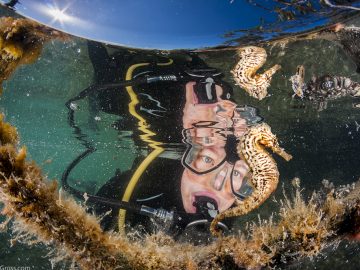
Managing a team whose mandate is to hold people accountable to their commitments has prepared me well for my next role. I am returning to The University of British Columbia in order to pursue my efforts to advance seahorse conservation. Seahorses are extraordinary fishes – they are the only animal we know of where the male gets pregnant, for just one example. And they are beautiful. But they are also overfished by the world’s most damaging fishing gears and traded internationally in huge numbers for use as traditional medicines. Because of this they are listed on Appendix II of The Convention on International Trade in Endangered Species (CITES). The listing means that all CITES Parties (member countries, now 182 plus the EU) are obliged to ensure that their seahorse exports are sustainable, legal and monitored. But for the listing to be effective in addressing the threats seahorses face, it needs to be more than a paper promise – it needs to be implemented. This summer I facilitated the Parties to adopt an action plan to move seahorse trade toward sustainability. This created a time-sensitive opportunity to hold CITES Parties accountable to the promises they have made for seahorses.
At the end of the day, having a gym membership doesn’t automatically make you fit. You need to show up and do the hard work.
At the end of the day, having a gym membership doesn’t automatically make you fit. You need to show up and do the hard work. It is promising to see more and more actors across the seafood supply chain taking out “sustainability memberships”. It’s a very important first step. But without showing up the membership will mean nothing at all. That’s why SeaChoice will continue to do the hard work of holding all actors accountable to their commitments. I’m proud of the progress my team has made so far, and can’t wait to see what they do next.
That’s me signing off. So long SeaChoice, and thanks for all the fishes!
ASC has changed its rules around treating sea lice – how “responsible” are the new rules?
The open nature of net-pen salmon farms means they are inherently susceptible to sea lice infections. Sea lice occur naturally in the wild ocean environment, but the “open” nature of net-pens allow the lice to infest farmed fish and multiply to unnatural levels. The lice can then infect any vulnerable juvenile wild salmon swimming by. Even low sea lice abundance on juvenile salmon can cause significant harm or death. Sea lice infestations are also a significant economic cost to the industry.
Parasiticides (i.e. chemicals) are regularly used by farms to combat sea lice infections. The chemicals have their own set of environmental impacts, as untreated discharge and fish excrement gets released directly into the ocean. Chemical resistance has become an increasing concern – resistance can leave farmers unable to control outbreaks. This was seen at Clayoquot Sound in 2018 where farms, including Aquaculture Stewardship Council certified farms, experienced sea lice outbreaks as high as 34 adult lice per fish. Meanwhile, wild salmon runs are left with the consequences.
It is therefore no surprise that parasiticide use is one of the sustainability concerns addressed by the ASC salmon standard. Unfortunately, the eco-label recently revised the number of chemical treatments allowed under its standard – and not for the better. The changes that go into effect at the end of this month dramatically increase the number of chemical treatments allowed in some salmon farming regions.
Here’s what the changes mean for ASC ‘responsibly farmed’ Canadian salmon.
First, farms on both coasts will be allowed to treat sea lice more often – with each treatment releasing parasiticides into the ocean environment and increasing the chance of chemical resistance. Many more treatments will be allowed on the east coast than in the west. Previously all ASC certified farms, regardless of their location, needed to meet a threshold of 2-3 sea lice treatments. Now, a B.C. salmon farm will be allowed 3-4 treatments, while an Atlantic Canada farm will be allowed as many as nine. Atlantic Canada farms will have up to eight years to work towards the 3-4 treatment threshold. And actually, an ASC certified B.C. farm might receive more than four treatments; an ASC interpretation means up to a year of production time can be excluded from the audit.1 During this time, environmental impacts such as sea lice treatments are simply ignored.
Second, east coast farms benefit from another change – the removal of precautionary lobster protections. Until now, farms were penalized for chemical treatments during the sensitive lobster moulting period because the chemicals can be incredibly toxic to lobsters and other crustaceans. But the amendment no longer penalizes farms for the use of chemicals that could have significant impacts on lobster populations and/or fisheries. Deltamethrin has been found to be “extremely toxic” to crustaceans and may be lethal to lobsters up to 10 km away and several hours after release. Cypermethrin has also been found to be “very toxic” to crustaceans. Another study found azamethiphos exposure could cause sub-lethal effects, including delayed spawning in female lobster and other physiological impacts.
Third, ASC has approved problematic variances (departures from standard criteria) that undermine the amendment’s Integrated Pest Management (IPM) requirements. The IPM requires certified farms to try and control sea lice using coordinated management practices (for example fallowing between cycles and chemical rotation), thereby reducing the risk of drug resistance. One requirement is that farms maintain lice loads of less than 0.1 mature female lice per fish. B.C. farms are exempt from this requirement, however, which has resulted in certified farms with lice counts of over 20 mature lice per fish. Another IPM requirement is area-based management. ASC’s own internal report found B.C. is the only salmon farming region without an ABM regulatory requirement. Like with the sea lice threshold, B.C. farms are exempt from the ABM requirement. Both the sea lice and ABM variances instead defer to Fishery and Oceans’ inadequate regulations.
It’s not all bad news – there are some positive changes in the amendment. The chemical hydrogen peroxide now counts toward the treatment limit count – it didn’t before even though studies have demonstrated that hydrogen peroxide may negatively impact non-target species, including lobster and the surrounding benthic fauna and flora. Farms are also now required to monitor benthic sediment for parasiticide residues – allowing for potential short-term and long-term effects of chemical treatments to be identified and better understood. Finally, farms are now required to publicly report chemical treatment types, amounts and frequency. This is an important change given that public disclosure is not the industry’s forte.
Certifications offer the potential to improve industry practices, but only when they go beyond industry norms and government regulations.
Certifications offer the potential to improve industry practices, but only when they go beyond industry norms and government regulations. While the ASC parasiticide amendments are still more rigorous than required by most other aquaculture certifications, these amendments no longer reflect ‘best practices’ in salmon farming. SeaChoice continues to urge the ASC to remedy any weakening of the standard, particularly the problematic variances and the variance process itself.
While ASC’s amendment might not meet the goal of ‘responsible’ aquaculture, the Prime Minister’s recently announced mandate to the Minister of Fisheries, Oceans and the Canadian Coast Guard is a promising step in the right direction. The Minster has been mandated to “work with the province of British Columbia and Indigenous communities to create a responsible plan to transition from open net-pen salmon farming in coastal British Columbia waters by 2025 and begin work to introduce Canada’s first-ever Aquaculture Act.” The transition of B.C. open net-pen salmon farms to closed containment by 2025 is one sure way to keep farm chemicals out of the ocean, and farmed derived sea-lice away from our wild fish (though we would like to see the transition extended to both coasts). Now that would be truly ‘responsible’ farmed salmon.