Category: Reports

  • Pattison Food Group receives an F on ethically sourced seafood

    Pattison Food Group receives an F on ethically sourced seafood

    In a new Seafood Progress report, Pattison Food Group (PFG) scores in last place across all retailers at 14%, indicating the major retailer is nowhere near taking accountability for the seafood it sells amid mounting evidence of environmental and human rights crimes in seafood supply chains.

    SeaChoice’s 7th Edition of Seafood Progress takes a closer look at which seafood products and stores retailers’ ethical sourcing policies cover, as well as the strategy behind these policies and how they are being applied in practice.

    The overall scores are as follows:

    1. METRO: 70% (C)
    2. Loblaw: 46% (F)
    3. Sobeys: 41% (F)
    4. Costco: 37% (F)
    5. Walmart: 22% (F)
    6. PFG: 14% (F)

    From 2018 to 2023, Save-On-Foods and Buy-Low Foods were profiled separately and annually on Seafood Progress. In 2021, The Jim Pattison Group announced in a press release that the two retailers – plus 11 other store chains – had merged under The Pattison Food Group umbrella as part of a restructuring that would allow its businesses to “increase efficiencies with lower operating and product costs.” To allow ample time for the amalgamation of its responsible sourcing policies, SeaChoice continued to profile Save-On-Foods and Buy-Low Foods separately in 2022 and 2023. 

    For the first time, SeaChoice profiles Pattison Food Group (PFG) against its seafood sourcing practices, strategies and plans for improvement. The results indicate PFG’s operations are decentralized and efforts on responsible seafood sourcing are seriously lacking. 

    Key findings include:

    1. Sustainable Seafood Policy is extremely outdated.

    PFG’s Sustainable Seafood Policy is that of Save-On-Foods, which has not been updated in nearly a decade and contains goals set to be achieved in 2016 and 2018. The Policy is far from ambitious with the goal of just 50% of its fresh and frozen private label and unbranded seafood being Ocean Wise Recommended. While Save-On exceeded this goal in 2023 having reported that 78% of its private and unbranded seafood had met its policy that year, the retailer has never increased its target beyond 50%. 

    1. Sustainable Seafood Policy is very narrow in scope. 

    In past Seafood Progress assessments we have explored the nature and supporting elements of retailer policies (do they have timebound goals, full chain traceability, etc). However, we have found that even the most robust policies are limited in scope. This is often not well communicated as retailers market their policies in a way that suggests they apply to everything and downplay which stores and products are excluded. To shine a spotlight on this issue, SeaChoice’s latest report takes a closer look at which seafood products and stores retailers’ ethical sourcing policies actually apply to, and which they avoid responsibility for. 

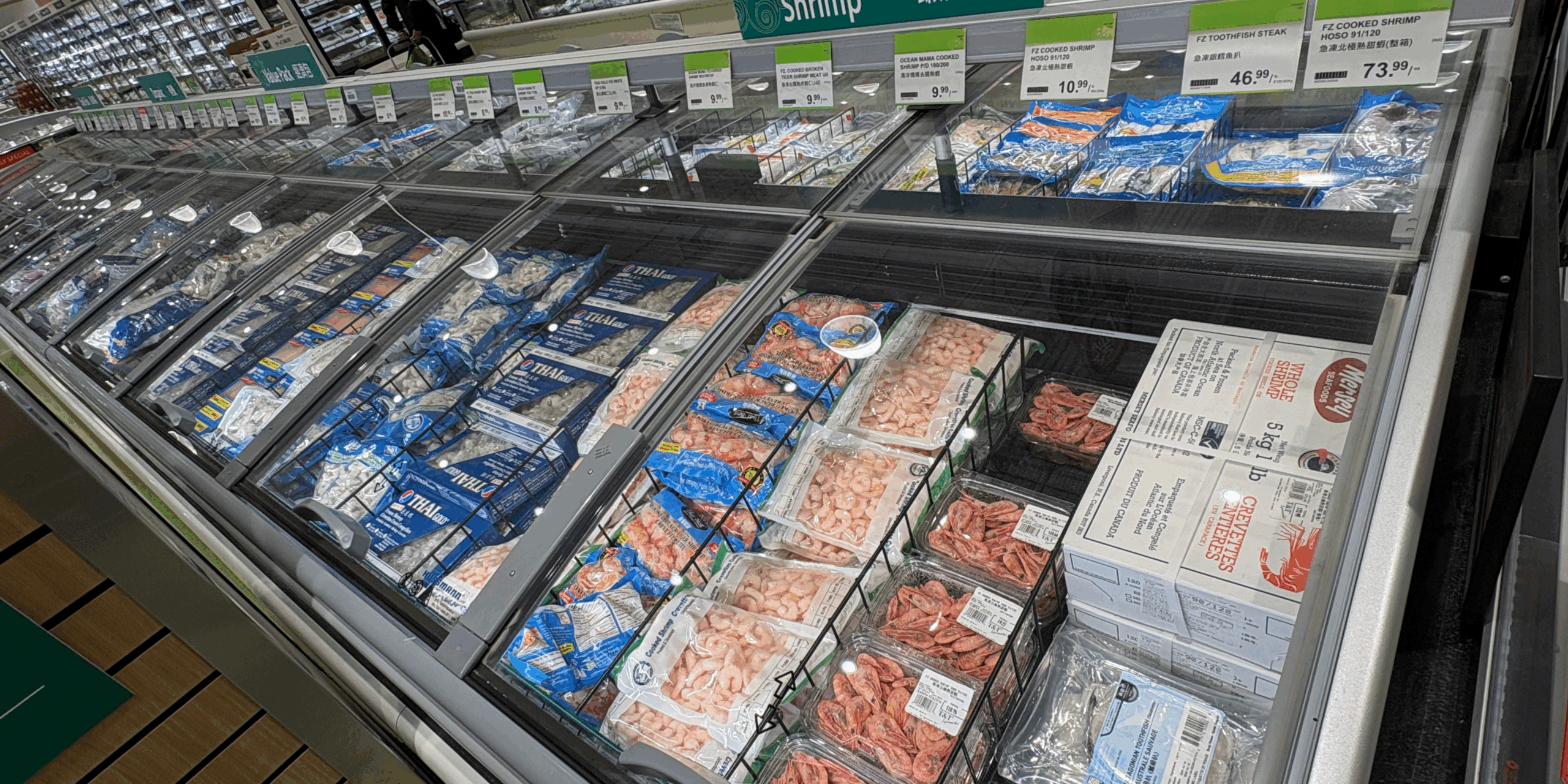
    PFG received the lowest score across all retailers as its Policy excludes all shelf stable, pet food, beauty, health and garden products that contain seafood as an ingredient. Additionally, its Policy appears to only apply to Save-On, which is just one of PFG’s thirteen store chains. The image below demonstrates that approximately 23% of PFG’s seafood products are covered by its Sustainable Seafood Policy. For information on how retailers were scored on the scope of their commitments, see our scoring methodology.

    1. Silence in the wake of major seafood investigations. 

    PFG did not respond to SeaChoice’s inquiry about whether the company plans to strengthen its efforts to ensure that its seafood suppliers comply with its Supplier Code of Conduct, amid growing evidence of abuse in global seafood supply chains. While none of PFG’s stores were directly implicated in The Outlaw Ocean Project’s China series where egregious human rights and environmental abuses were connected back to seafood products sold by North American retailers, a supplier of Save-On-Foods’ private label seafood — Premier Marine Canada — was. Correspondence between Outlaw Ocean and Premier Marine can be found here. Various third-party seafood brands that are commonly sold in PFG’s stores were also implicated (e.g., Aqua Star, High Liner and Toppits). 

    1. Still does not trace seafood from the vessel or farm to its store shelves.

    Save-On has reported annually to SeaChoice since 2018 that it is working on obtaining full chain traceability of its seafood products. Seven years later, the retailer has yet to report meaningful efforts in this area. PFG must demonstrate traceability in its own operations as well as demand the same from its suppliers so that the retailer is in a position to identify risks and investigate issues behind its seafood products. 

    1. Lack of strategy or plans to ensure ethical seafood sourcing. 

    PFG did not report any plans to include the many products and stores currently out of scope of its Sustainable Seafood Policy, and traceability remains a stale goal. On the human rights side, PFG is far behind its competitors as, according to its 2023 Forced Labour Report, the retailer just created its first Supplier Code of Conduct (SCoC) in 2023. What’s more, PFG is the only retailer not to publish its SCoC and does not take any measures to verify that suppliers are upholding it. Finally, PFG did not report plans to incorporate worker perspectives into its HRDD process in relation to seafood, which is a critical component to effective HRDD. 

    1. Seafood policies are not well embedded in operations. 

    This report indicates PFG’s seafood policies are very decentralized across its store chains. PFG informed SeaChoice that responsibility and accountability for the implementation of its Sustainable Seafood Policy currently varies by banner, as some banners are fully integrated in the larger PFG supply chain, and others are not yet (personal communication, PFG, 18/02/2025). Furthermore, PFG’s 2023 Forced Labour Report states: “We are at the relative beginning of creating formalized processes and policies to address forced labour and child labour in the supply chains of the products we procure.” FishWise’s Human Rights Due Diligence (HRDD) Fundamentals report states that a company’s HRDD implementation must be seen not as a side project, but as a core part of doing business. 

    On the upside, SeaChoice would like to acknowledge that PFG was quite transparent when asked questions about its Sustainable Seafood Policy. Furthermore, we are encouraged to learn that Buy-Low has upheld its historic commitment to not sell any farmed salmon through the merger. PFG also reported that it “has been looking into how to execute and integrate supply chain mapping and risk assessment for some time, and that it has been able to further resource this area over the past year to make gains in its capacity. The growing awareness of human rights issues in extended supply chains further emphasizes this need. PFG is currently evaluating the most feasible and effective means to verify working conditions related to seafood” (personal communication, PFG, 20/02/2025).

    While this update is encouraging, it is critical that retailers stop kicking the can down the road and start walking the talk on environmental and human rights due diligence. Considering Save-On-Foods is one of the fastest growing grocers in Western Canada and the merger was a move intended to increase operational efficiencies and therefore profits, it’s high time PFG’s responsible seafood sourcing efforts caught up. 

    Send a letter to retailers demanding they stop selling unethical seafood and take accountability for their products. 

  • SeaChoice calls for Canada to include misleading certification claims in greenwashing rules

    SeaChoice calls for Canada to include misleading certification claims in greenwashing rules

    Greenwashing – misleading and unsubstantiated environmental claims – is a serious problem that can undermine true sustainability efforts and consumer confidence. That’s why Canada needs rigorous rules and robust guidance for businesses that encompasses all actors that may engage in greenwashing.

    Last June, new greenwashing amendments to Canada’s Competition Act were adopted that would require companies to use an “adequate and proper test” or “internationally recognized methodology” to back up their environmental claims. Since then, the Bureau has been working on guidelines for businesses to help explain what these requirements actually mean.

    Following an initial consultation, where SeaChoice urged the Bureau to establish rigorous greenwashing guidelines that encompassed all claim types, draft guidelines for businesses were recently published for feedback. 

    These proposed guidelines lack, well, guidance. 

    In our latest SeaChoice submission we highlight that the ambiguity built within the proposed guidelines is problematic. In particular, the Competition Bureau’s proposed guidelines for environmental claims, as drafted, provides an extraordinary amount of leeway regarding what may qualify as “adequate and proper test” and “internationally recognized methodology”. Such ambiguity and leeway opens the door for certifications to evade scrutiny by the Bureau and could result in greenwashing associated with certification claims to continue unmitigated in the Canadian marketplace.

    Concerningly, but not surprisingly, during the initial consultation, certification schemes advocated to the Competition Bureau that certifications should qualify as “internationally recognized methodology” (and thereby evade scrutiny by the Bureau). 

    While certifications are often viewed as validating sustainability claims and preventing greenwashing, research also suggests that they can inadvertently contribute to and even incentivise greenwashing. Researchers also point out that all too often government regulations, designed to hold actors accountable for greenwashing, do not require certifications to substantiate their environmental claims. 

    Environmental and social organisations have been increasingly vocal on concerns about certifications. SeaChoice and allies have long called out the Marine Stewardship Council (MSC) for awarding certification to unsustainable fisheries. We have also called out farmed seafood certifications, Aquaculture Stewardship Council (ASC), Best Aquaculture Practices (BAP), and GlobalG.A.P. numerous times. Investigative journalism and whistleblower testimonies have uncovered breaches of certification standards and auditing practices. 

    And it’s not just seafood certifications. The issue is systemic across commodities and certifications – including forestry, palm oil, cotton, soy, cocoa, coffee, and more. 

    For example, civil society investigations into the Forest Stewardship Council (FSC) and the Programme for the Endorsement of Forest Certification (PEFC) certificates which have also found the trafficking of illegal timber. A study found the Roundtable on Sustainable Palm Oil certification to be “meaningless” as 75 percent of certified plantations had been deforested or located in areas with endangered species.  The authors emphasized “certification does not ensure environmental sustainability “.  The Better Cotton Initiative certification has been linked to land grabbing, illegal deforestation, corruption, and human rights abuses. Other certifications that have been criticized include soya, cocoa, and coffee certification schemes.

    While the above examples don’t mean that all certified products or businesses are greenwash, it does highlight that greenwashing by certifications can and does occur.  

    This is why SeaChoice has strongly advised that the Bureau does not simply defer to certification schemes as “adequate and proper” tests or automatically qualifying as “internationally recognized methodology”.  

    SeaChoice urges the Competition Bureau to make the expectation to all businesses that all  potentially misleading environmental claims, including certifications, will be investigated for greenwashing. 

  • Seafood Labor Activists Demand MSC Acknowledge Its Role in Enabling Labor Abuse

    Seafood Labor Activists Demand MSC Acknowledge Its Role in Enabling Labor Abuse

    *Reposted – Original Press Release here.*

    Author: Seafood Working Group
     

    Washington D.C. – Global Labor Justice (GLJ) and allies in the Seafood Working Group (SWG) today issued an open letter to the Marine Stewardship Council (MSC), calling on the certification body “to take responsibility for the role of its social policies and processes in enabling the abuse of workers in certified fisheries, and its attendant role in instances of certifying fish produced under conditions of labor exploitation.”

    The letter, signed by several SWG members—including Global Labor Justice (GLJ), International Transport Workers’ Federation (ITF), Humanity United, Freedom Fund, and Greenpeace US cited rampant labor abuse in the hazardous seafood industry:

    “The fishing sector is rife with severe labor abuses, with at least 128,000 fishers subjected to forced labor. The industry is also extremely dangerous, with over 100,000 fishers losing their lives each year due to hazardous working conditions. Many fishers face grueling hours, withheld wages, abusive conditions, and extreme isolation, often with little to no protections or recourse. Despite these alarming conditions, seafood from such fleets continues to enter European and U.S. markets. This systemic disregard for fishers’ labor rights in the seafood sector is unacceptable and must urgently be addressed.”

    Due to increasing attention to the exploitation of migrant fishers and recent reports of forced labor incidents in MSC-certified fisheries, the MSC is facing scrutiny for failing to take responsibility for how its social policies and processes contribute to unchecked labor abuse in certified fisheries. Rather than accepting its role in certifying fish produced under exploitative labor conditions, the MSC is distancing itself from responsibility.

    Member organizations within the SWG have called on the MSC to be transparent, ensuring that all stakeholders—including consumers—understand that the MSC ecolabel does not, and cannot, safeguard against labor rights violations. Additionally, the letter demands that MSC must inform companies that relying solely on the MSC ecolabel for sourcing decisions without considering labor standards enables labor exploitation of workers and exposes companies to significant reputational risks. As the MSC does not provide adequate assurance for the protection of labor rights, the letter recommends that the MSC clearly acknowledge the label’s limitations, actively and publicly endorse legally binding solutions to effectively protect fishers’ labor rights, and promote other mechanisms that allow workers to assert their collective agency to monitor, enforce, and remedy labor rights violations.
     

    Read the full letter here

    The MSC’s business model relies on the fishing industry. With 88.7% of its revenue coming from royalties on products that carry its logo, it has an embedded financial interest in keeping major fisheries in its program, even where there is evidence of forced labor without meaningful or credible efforts to prevent and remedy it. Rather than guaranteeing high labor standards, the MSC logo provides false cover– since companies know they can get the MSC’s logo on their products without addressing labor violations, they have less incentive to do so.

    ###

    Global Labor Justice(GLJ) is a non-governmental organization that works transnationally to advance policies and laws that protect decent work; to strengthen freedom of association and workers’ ability to advocate for their rights; and to hold corporations accountable for labor rights violations in their supply chains.

    The Seafood Working Group (SWG) is a global coalition of human rights, labor, and environmental organizations that work together to develop and advocate for effective government policies and industry actions to end the related problems of labor exploitation, illegal fishing, and overfishing in the international seafood trade.

  • Is your seafood Canadian? Making sense of origin labels 

    Is your seafood Canadian? Making sense of origin labels 

    With the threat of trade tariffs imposed by the United States, many Canadian consumers are taking a closer look at where their food (including seafood) comes from. The problem is origin statements on labels can be confusing and sometime difficult to know if a product is of Canadian origin.  

    Let’s breakdown the situation. 

    Firstly, it’s important to understand that the government doesn’t require an origin label for Canadian products that are produced (i.e., farmed, fished) and/or processed in Canada. However, they do allow companies to voluntarily make a Canadian origin claim and provide guidance on how to do so.  

    Some slight differences in the wording for these voluntary Canadian origin claims exist that consumers should be aware of:  

    If you see “Product of Canada” on a label, it means that “all or virtually all major ingredients (at least 98%), processing, and labour used to make the food product are actually Canadian. For seafood, this translates to fish or seafood produced or caught in Canada or within Canadian waters and processed in Canada using Canadian ingredients. Also note that if you see the claim “Canadian” the government deems this to be equivalent to a “Product of Canada” claim.  

    If you see “Made in Canada”, this only means the last substantial transformation (ie processing) occurred in Canada, even if some ingredients are imported. For seafood, this could look like a fish that is imported from another country but processed in Canada. The guidance for these labels also states that the claim should include a statement to indicate if the seafood was made with imported or both imported and domestic products, such as “Made in Canada from imported ingredients”. However, these types of statements are often in fine print, as shown in the example below. And most importantly, the true origin – where the seafood was caught or harvested doesn’t actually have to appear on the label. In fact, 2023 Seafood Progress results found half the major Canadian retailers profiled don’t label any of their seafood products with the true origin.  

    But wait – Canadian seafood could be hiding under the guise of another country of ‘production’.  

    Here’s where it gets a bit trickier. By law, any imported prepacked seafood must be labelled with the “country of origin” and by the government’s definition, this refers to where the food was last substantially transformed (i.e. processed), not its true origin. Due to the global nature of seafood trade, fish and shellfish are often caught or harvested in one country/region then processed in another. For example, an Atlantic Halibut caught in the Gulf of St. Lawrence by a Canadian fishing vessel may be exported to China for processing into fillets, then imported back into Canada with a label that says, “Product of China”. 

    This labelling rule makes it difficult to support Canadian fishers and farmers, because the label doesn’t necessarily identify the true origin.  

    This is why SeaChoice has been advocating for years for the law to require seafood labels to be more detailed and provide the true origin of seafood. This is the only way we will ever be able to know for certain where our seafood comes from. 

    So, how best to support and buy Canadian seafood? 

    Apart from looking out for the “Product of Canada” voluntary claim to know that you are supporting both Canadian produced and processed seafood, SeaChoice recommends you buy directly from Canadian fishers and harvesters. Two companies that SeaChoice recommends are Afishionado Fishmongers for those based on the East coast and Skipper Otto for those in central Canada and the West coast.

    To help drive change on the water, we invite you to subscribe to our newsletter.

  • BC salmon farmers switch eco-labels, but still on the Avoid list

    BC salmon farmers switch eco-labels, but still on the Avoid list

    Last month Grieg Seafoods canceled their Aquaculture Stewardship Council certificates, leaving zero ASC certified salmon farms in Canada. But the eco-labelling of Canadian farmed salmon continues under an alternative certification, Best Aquaculture Practices.

    Both certification schemes have had their credibility questioned over the years. Most recently, BAP has been the subject of a US Federal Trade Commission petition for potentially misleading marketing claims. 

    So how did we get from BC salmon farmers holding the ASC up as the ‘gold standard’ to dropping it like a hot potato? And what does this change to BAP mean for grocers and seafood shoppers?

    Spoiler: despite a change in eco-labels, salmon farming remains on the red list.

    Prior to the creation of ASC, the salmon farming industry including companies operating in BC, participated in the multi-stakeholder Salmon Aquaculture Dialogues that would eventually establish the ASC Salmon Standard. At the time SeaChoice member groups, David Suzuki Foundation and Living Oceans, alongside other NGOs, also participated in the Dialogues in efforts to prevent the industry creating a weak standard (in the end we voted against the final standard). All up, these Dialogues took nearly a decade.

    In 2014, the Global Salmon Initiative – then 15 salmon farming companies including multi-nationals Mowi (then Marine Harvest), Cermaq and Grieg – had committed to certifying 100% of their operations by 2020. The pressure to become ASC certified was on. 

    Once the ASC Salmon Standard was operationalized, environmental requirements from the years-long dialogues were quickly eroded – seemingly overnight – at the request of industry and auditors. BC farms were exempt from the Standard’s sea lice requirements, and the number of parasiticide chemicals treatments allowed increased by 350 per cent in some regions.

    In 2015, the first ASC farm in BC was certified – with seven sea lion deaths, dangerously high sea lice numbers that peaked at 23 lice per fish that SeaChoice members Living Oceans challenged in a complaint. Such outrageous practices continued to be certified throughout the decade of ASC in BC and revisions to the salmon standard increasingly reflected business as usual industry practices. That said, some credit must be given to ASC for heeding SeaChoice’s calls to include local stakeholders in processes, and a long due commitment to rectify their problematic exclusion of intermediary farms from audits. 

    While the number of ASC farms and volumes did multiply rapidly, the GSI companies never did meet the 100% by 2020 ASC commitment. Then 2020 passed, Mowi left the GSI and all BC companies started to decrease their ASC volume until there was no more (though the GSI continues to state companies, including those in BC, are committed to ASC). 

    Instead BC salmon farmers joined their east coast salmon farming counterparts by signing up to the Best Aquaculture Practices – the certification scheme of the industry-dominated trade association, Global Seafood Alliance. 

    BAP and its claims of ‘best practices,’ ‘responsible,’ ‘sustainable,’ and the like has received much criticism from civil society groups. Last May, 76 global groups denounced the latest BAP farmed salmon standard as greenwash in an open letter. The letter listed damning evidence of numerous BAP certified farms and facilities associated with environmental damage, illegal activity, and/or negative impacts to endangered species. Examples were found in all of the following major salmon farming regions: the U.S., Norway, Chile, Scotland, Australia – and Canada. 

    Alarmingly, the BAP certification has also been associated with human rights abuses. A long investigation by Corporate Accountability Lab and a whistleblower exposé by The Outlaw Ocean Project detailed forced labor, hazardous child labor, dangerous working conditions and more associated with the Indian farmed shrimp supply chain, including farms and processing facilities that are BAP certified. Environmental damage and banned antibiotics were also uncovered. The farmed shrimp was tracked back to major grocers in North America. In November 2024, CAL and the Southern Shrimp Alliance submitted a petition to the US Federal Trade Commission requesting action against BAP for false or deceptive advertising. 

    Despite these criticisms and serious allegations, a significant number of major grocers continue to rely on BAP as part of their responsible seafood sourcing policies. 

    As evident in our Seafood Progress results, all large Canadian grocers happily accept ASC and/or BAP farmed salmon (rare exception: Buy-Low Foods dropped farmed salmon years ago!). Their reliance on questionable certifications leaves them vulnerable to criticisms and brand risk

    SeaChoice recently highlighted the problem of greenwashing on seafood products in the Canadian marketplace in our submission to the Competition Bureau. We called on the Canadian Government to establish tough rules, including those for certifications.

    And finally, our Public Service Announcement: 

    ASC certified. BAP certified. ‘Responsibly sourced’. Seafood shoppers – don’t fall for eco-labels on farmed salmon! Open net pen BC farmed salmon remains not recommended by Ocean Wise and on the Seafood Watch red-list (Avoid). 

    To help drive change on the water, please subscribe to our newsletter

  • SeaChoice enters 2025 with new alliances

    SeaChoice enters 2025 with new alliances

    During 2024, the slew of exposés of human rights abuses within global seafood supply chains highlighted that corporate policies, voluntary certifications and social audits, along with government regulations, are not enough to prevent such atrocities entering the Canadian marketplace. 

    It underscores the need for companies to shift to a due diligence approach (i.e., the ongoing process of identifying and responding to potential and actual adverse human and environmental impacts within their supply chains) – one that goes beyond certifications and takes responsibility for all products sold in store. 

    Due diligence guidance already exists for companies in the form of the OECD Guidelines for Multinational Enterprises on Responsible Business Conduct. The guidelines were updated in 2023 to further incorporate climate change, biodiversity, animal welfare, workers rights, and more. 

    In 2024, the Conservation Alliance for Seafood Solutions updated their Guidance for Companies on Environmentally and Socially Responsible Seafood to reflect the OECD Guidelines. 

    Yet due diligence within major grocers and seafood companies remains elusive. 

    To help change this, SeaChoice has joined forces with OECD Watch – a global civil society network with more than 140 members across 50 countries; and the Canadian Network on Corporate Accountability – a network of more than 40 Canadian civil society groups. SeaChoice is the first group focused solely on seafood supply chains to join both networks. 

    Both groups advocate for ambitious due diligence legislation to be adopted. CNCA is calling for the Canadian Government to establish a Due Diligence Law. The European Union has already set the precedent for such a law with the establishment of the Corporate Sustainability Due Diligence Directive (though how robustly each EU member state implements the directive remains an issue that OECD Watch closely monitors). 

    One adverse impact unique to global seafood supply chains is illegal, unregulated and unreported (IUU) fishing.  

    SeaChoice partner organization, Ecology Action Centre, joined the IUU Action Alliance as an NGO supporter. The IUU Action Alliance, formed in 2023, is a coalition of governments and organizations that are committed to ending IUU fishing globally. 

    IUU fishing is a prevalent issue that leads to the destruction of marine ecosystems and impacts the livelihoods of honest harvesters. Tackling this issue requires a coordinated effort globally toward greater traceability, enforcement and sustainability. 

    Ecology Action Centre will bring SeaChoice’s expertise and Canadian fisheries perspective to the coalition to tackle this critical issue and hold the Canadian government accountable.  

    Stay tuned over 2025 as we continue to push the Canadian marketplace, certifications, and decision-makers towards due diligence being the norm – not the exception!

    To help drive change on the water, we invite you to subscribe to our newsletter.

  • Human Rights Day can be a moment for corporate accountability

    Human Rights Day can be a moment for corporate accountability

    Op-ed by Shane Moffat, director of the Canadian Network for Corporate Accountability, as featured in the Hill Times

    Human Rights Day on Dec. 10 comes at a critical moment for corporate accountability in Canada. With the right political will, there are immediate opportunities to prevent people around the world from being harmed by companies based right here.

    A federal review of the Canadian Ombudsperson for Responsible Enterprise (CORE), and imminent talks on a global binding treaty on business and human rights are key moments for the government to show its commitment to human rights, and start solving the global problem of corporate impunity.

    Most people would be surprised to learn that companies bringing goods into Canada are not legally required to prevent human rights abuse or environmental destruction during their production. The same goes for Canadian companies operating overseas. Aside from ineffective voluntary guidelines, we don’t have laws requiring them to respect the rights of local communities, workers, or Indigenous Peoples. These are our global neighbours, extended families, and, in many cases, literally our brothers and sisters.

    Shane Moffatt is the director of the Canadian Network on Corporate Accountability. As a consequence, Canadian companies operating abroad or importing products are associated with widespread and egregious human rights abuses, including forced labour, serious environmental damage, and even killings. Whether it’s through the clothes on our backs, the food on our plates, or the metal in our phones, this issue touches all of us daily. That’s why the Canadian Network on Corporate Accountability has been calling for CORE to have the powers it needs to investigate complaints by affected people, and compel corporations and their representatives to testify. Sometimes referred to as “Canada’s corporate watchdog,” the government initially promised these powers, but has since kept CORE as a toothless tiger. As a result, impacted communities risk wasting their time if they file a complaint.

    Right now, Global Affairs Canada is conducting a five-year review of CORE’s effectiveness. In a submission last month, we argued for these powers, and pointed out that all provincial ombudspersons are able to compel witness testimony and the production of documents under oath. The previous CORE ombudsperson Sheri Meyerhoffer apparently agrees with us. Furthermore, CORE’s mandate only covers a very small number of industries—garments, gas, oil, and mining—despite the government creating an expectation of a much more comprehensive scope. It shouldn’t matter what sector a company is involved in—they have no business violating people’s human rights.

    Trade Minister Mary Ng, who is responsible for CORE, has a long way to go to fulfil her mandate to “ensure that Canadian businesses operating abroad do not contribute to human rights abuses.” Fixing CORE would be a step in the right direction.

    Ng will also be under pressure to play a constructive role in upcoming talks on a business and human rights treaty taking place in Geneva from Dec. 16-20. This year marks the 10-year anniversary of discussions towards a legally binding treaty. If enacted, such a treaty would require all state parties to prevent companies based in their jurisdictions from being involved in human rights abuse anywhere in the world.

    To date, talks have proceeded slowly, and not secured adequate support from countries like Canada in the Global North. Canada has a particular responsibility to support this process given the significant number of extractive industries headquartered in this country, and extensive global supply chains connected to enormous loss of biodiversity and harm to local communities.

    Our network has just written to the trade minister urging the government to ensure formal treaty negotiations finally move forward, and to commit to urgent domestic measures: fixing CORE, and passing new legislation to stop Canadian corporations from committing all forms of human rights abuse overseas in the first place. The government’s failure to enact mandatory human rights and environmental due-diligence legislation remains a major source of frustration for human rights, faith, labour, and environmental groups across the country.

    At the end of the day, multinational corporations are devastating people and the planet through a vast network of interconnected industrial and extractive activities worldwide. Frontline communities and workers are too often bearing the brunt. In large part, this is due to a lack of accountability for corporations based in Canada and the Global North. This is driving social inequalities, and an ecological crisis affecting us all.

    Instead of being part of the problem, the government now has an opportunity to be part of the solution by supporting a global treaty, and strengthening CORE so communities can have access to justice and meaningful remedies when Canadian corporations cause them harm. It’s the least they can do.

  • Dramatic showdown over shark finning at this year’s ICCAT meeting

    Dramatic showdown over shark finning at this year’s ICCAT meeting

    This year’s meeting of the International Commission for the Conservation of Atlantic Tunas (ICCAT) wrapped on November 18th with a dramatic showdown over shark finning.

    SeaChoice partner organization Ecology Action Centre was in attendance advocating for this crucial fishing rule: requiring all Atlantic fishing nations to bring sharks to port with their fins still attached — the “fins-naturally-attached” policy. This rule would strengthen enforcement, improve shark identification, and help end the wasteful practice of shark finning at sea in the Atlantic.

    ICCAT did manage to finalize protections for devil rays, mantas, and whale sharks, took steps to improve countries’ compliance with existing requirements to report and limit shark catch and adopted a Management Procedure for North Atlantic swordfish.

    To help drive change on the water, we invite you to subscribe to our newsletter.

  • First shareholder resolution in the world to prevent a species extinction lands historic vote

    First shareholder resolution in the world to prevent a species extinction lands historic vote

    Over the last month, companies faced the world’s first shareholder resolutions over knowingly contributing to the demise of an endangered species. It is a sign that companies, including major grocers, can no longer ignore their role in halting and reversing nature loss. 

    Biodiversity or nature loss threatens the survival of one million species and has the potential to impact the lives of billions of people. More than half of the world’s GDP, equivalent to US $58 trillion, is moderately or highly dependent on nature. The World Economic Forum Global Risks Report 2024 identifies biodiversity and ecosystem collapse as the third most severe risk over the next ten years. In other words, it is in the interest of businesses, investors, people, – and nature – that companies urgently take action to address nature-risk within their supply chains.

    The 2022 Kunming-Montreal Global Biodiversity Framework set ambitious targets for halting and reversing nature loss for governments and businesses. Target 15 calls for companies to “progressively reduce negative impacts on biodiversity”. Given only 5% of companies understand their impact on nature, much work remains to be done. 

    Thankfully a growing number of investors are taking nature-risk seriously. More than 230 institutional investors, representing more than $30 trillion in assets or advice, have formed Nature Action 100. The global collaboration has identified 100 companies from key sectors with a high potential of impact on nature. Their recently published benchmark found most companies are in the early stages of disclosing commitments to protect nature, but few have tangible assessments or plans. For example, some companies have signed on to the Taskforce on Nature-related Financial Disclosures (TFND), however, real action awaits. 

    Investor expectations for companies to disclose their nature-risk impact was recently tested with the first-of-its-kind shareholder resolution calling for major supermarkets, Woolworths Group and Coles Group, to report and disclose the impact their farmed seafood has on endangered species. Woolworths is ranked 23rd and Coles is 35th on the list of the world’s largest retail companies. Combined they control 65% of the Australian retailer market. Woolworths is on Nature Action 100’s target companies. 

    The voting results were historically significant. Nearly 40 per cent (39.11%) voted in favour against the Coles board’s recommendation. A large vote was also achieved with Woolworths (30.42%). Of the 550 plus shareholder resolutions put forward this year worldwide, the Coles vote was the:

    • Largest in the world for a nature risk resolution this year
    • 4th Largest in the world for a nature risk resolution ever
    • Largest in Australia for any type of resolution since 2021

    Importantly, the voting includes several international and national pension funds representing millions of members. This sends a strong message to the boards that nature-risk is a serious concern. 

    And it appears the supermarkets have taken note (though arguably not at the urgency required). So far, Coles has begun reducing their salmon sourcing from the area impacting the endangered Maugean skate; and Woolworths pledged greater transparency on their salmon sourcing.

    The shareholder resolutions were put forward by the Save the Skate collaboration that includes SeaChoice member group Living Oceans Society, as well as SIX Invest, Environment Tasmania, Neighbours of Fish Farms, Eko, and several ethical funds.

    While this historic resolution and vote targeted Australian supermarkets, consider this:

    The companies just so happened to be major supermarkets with sustainable seafood policies. Despite their policies, their farmed salmon procurement is associated with an extinction event. And this very salmon is certified and labelled as “responsible”.

    Sound familiar? The above scenario could easily, sadly, apply to Canadian grocers who rely on not-fit-for-purpose certifications as part of their sustainable seafood policy. 

    Canadian companies must take note of global expectations in regards to nature risk – because their companies bottom line – and our planet – are at stake.

    (PS: The Canadian government also needs to act  – tell your MP to support investments in nature protection and legislation)

    To help drive change on the water, we invite you to subscribe to our newsletter