Category: Reports

  • Seafood Progress – Year 4 Results

    Seafood Progress – Year 4 Results

    As we gradually emerge from the global pandemic, there is a chance to build a more sustainable and responsible economy. The strain on grocery stores has created an opportunity to innovate supply chains, policies and processes. In terms of the seafood supply chain, Seafood Progress has shown satisfactory improvements from most Canadian retailers in the past year. 

    This is the fourth year that Seafood Progress has profiled Canada’s eight major retailers to assess what they are doing on seafood sustainability. Costco Canada has been the only retailer to refuse to engage with us since the start of Seafood Progress and therefore its profile is based solely on publicly available information. Costco’s scores further plummeted this year due to lack of information about its current activities to support seafood sustainability. As such, we have decided not to factor Costco’s scores into the national average calculations to better represent the actual average among participating retailers.

    Despite retailers’ improvements in the past year, there is much work to be done. For example, Seafood Progress has actually shown a slight decline in scores for retailers’ commitments to social responsibility since 2019 as most lack traceability policies to support their commitments. As many reports like this one and this one have documented, social responsibility is an area of growing concern in the global fishing industry. Canadian retailers have a responsibility to ensure they are only selling seafood products that meet human rights standards. SeaChoice continues to encourage retailers to invest in processes that will track key sustainability information about products from the point of harvest to the point of sale in order to support efforts to reduce the risk of labour abuses and seafood fraud. 

    This year we introduced two new key performance indicators (KPIs) to Seafood Progress to bring more attention to the scope of retailers’ commitments. The first KPI considers how many banners the retailers’ commitment applies to. Banners are store brands that large retailers own and operate and which are tailored to meet different customer needs. The second KPI considers if the categories in most need of improvement – national seafood brand products (e.g. Cloverleaf or Highliner) and shelf stable products (e.g. canned tuna) – are covered under retailers’ commitments. 

    We were pleased to report that on average, retailers’ commitments apply to 96% of their store banners. In terms of product scope, we were encouraged to learn that both Federated Co-operatives Ltd (Co-op) and Walmart Canada have expanded the scope of their commitments in the past year to include all seafood brand and shelf stable products. This brings the number of retailers that include shelf stable seafood brand products from two to four out of eight – a step in the right direction!

    Other notable improvements include Buy-Low Foods’ decision to collaborate with SeaChoice and its NGO partner, Ocean Wise Seafood, to introduce comprehensive signage in all store locations to help educate consumers on its sustainable seafood policy. Additionally, both Buy-Low Foods and Co-op improved their data collection efforts which has led to both achieving perfect scores under Step 2. Seafood Progress celebrates continuous improvements by retailers, and as such we would like to congratulate Buy-Low Foods and Co-op for being the two retailers with the most improved scores over the past year. We would also like to commend METRO, Save-On-Foods and Buy-Low Foods for their outreach to the Canadian government in support of an electronic and interoperable boat-to-plate traceability program for all seafood sold in Canada. METRO also joined two pre-competitive groups focused on seafood traceability and DNA testing this year. 

    As one of the most important stakeholders in the grocery ecosystem, retailers listen closely to what their customershave to say. To leverage that power and help drive important changes throughout the supply chain, visit SeafoodProgress.org and explore the options to reach out to your retailer from their profile page.

    And remember to stay updated on Seafood Progress by subscribing to our newsletter! Sign up by entering your email below the “Related News” section.

  • Behind those ‘responsibly farmed’ seafood labels

    Behind those ‘responsibly farmed’ seafood labels

    Including NGOs in aquaculture certifications is key to preventing industry greenwash

    Canadian shoppers care about sustainable seafood. More than two-thirds check for eco-labels, including certifications, at least some of the time. By preferentially choosing eco-labelled seafood products over ones without, shoppers place their trust in that eco-certification, its sustainability promise and the systems behind it. But it is who is included or excluded in those behind-the-scenes systems that make an eco-certification legitimate or a potential greenwash.

    As advocates for environmental protection and social responsibility, non-governmental organisations (NGOs) have a significant stake in certification decisions, provide invaluable expertise, local knowledge and oversight of industry. Likewise, for Indigenous peoples and other local communities. These stakeholders can grant legitimacy to a certification. When legitimacy is not granted, this can lead to public facing campaigns and criticisms. 

    The three most prominent aquaculture eco-certifications, Aquaculture Stewardship Council (ASC), Best Aquaculture Practices (BAP) and GLOBALG.A.P., act as authorities for defining farmed seafood sustainability. Their eco-labels can be found on farmed seafood such as Atlantic salmon, shrimp, basa and tilapia. Retailers often cite them in their sustainable seafood policies. Aquaculture companies become certified in hopes of gaining a social licence, market access and premium prices. 

    SeaChoice’s latest report, Accountability in Seafood Sustainability: Improving the legitimacy of aquaculture certifications through better transparency and stakeholder inclusivity, reviewed the extent to which ASC, BAP and GLOBALG.A.P. are a product of and a platform for civil society stakeholder engagement. Here is some of what we found:

    • All three certifications engage with civil society stakeholders in some form or another, though, some more so than others. At a basic level, each provides stakeholder consultation opportunities during the development and revision of their standard(s). But the opportunities differed when we looked at governance structures and farm audit processes.
    • The GLOBALG.A.P. certification lacks civil society stakeholder representation on its standard-development and governance bodies. Instead industry members exclusively hold these positions. When eco-certifications instill a multi-stakeholder balance within their governance structures, they help ensure all opinions are fairly represented and considered. ASC and BAP includes civil society and industry stakeholders on their respective governance bodies. 
    • It is an unfortunate truth that, globally, aquaculture operations often lack transparency and consultation – both from the industry and governments. Concerningly, our report found some auditing practices of the voluntary eco-certifications are no better. For example, consumers and civil society stakeholders won’t find any published audit reports to demonstrate a farm’s compliance with the BAP or GLOBALG.A.P. standards. In addition, both lack a requirement to consult with local stakeholders during farm audits. This means that valuable expertise and on-the-ground oversight, as well as local knowledge and concerns, are being ignored. In comparison, ASC certified farms are subjected to audits that include local stakeholder consultation and audit reports are published. 
    • We also found that the ASC was the only aquaculture certification that has conducted and published a monitoring and evaluation (M&E) program. M&E programs are critical for demonstrating to all stakeholders how a scheme is performing against its stated theory of change or objectives (e.g., to improve the sustainability of aquaculture operators). 

    In short, eco-certifications are less likely to be considered ‘greenwash’ if they have buy-in and support from civil society stakeholders. But obtaining such support means schemes need to be inclusive and transparent – or risk being seen as ‘the fox guarding the henhouse’.

    So, should you continue to buy that eco-certified seafood? Generally speaking, yes. Another SeaChoice report found that independent eco-certification claims were more reliable and verifiable than self-declared environmental claims by companies. But no certification is perfect. This is why SeaChoice and other civil society groups advocate for improvements while calling out the egregious as necessary.

    Nor is certification alone the only solution to fixing the problems of farmed seafood (or whichever commodity it is). Governments need to ensure stronger regulations while protecting sensitive habitats and species (such as the removal of open-net pen salmon farms from Canadian waters). Retailers and seafood companies need to make sure their supply chains are not contributing to environmental degradation and social harms (see Seafood Progress to view how your local supermarket performs). 

    Finally, sometimes we don’t need to rely on eco-labels to tell us the best options for the health of our planet: recycled paper, electric vehicles, solar power. These are all better options in their commodity fields. Likewise, there are some farmed seafood options – such as shellfish and seaweed – that are inherently more sustainable regardless of whether or not they have a certified label. Moules frites, anyone?

  • Is the seafood sold in Canada’s retailers immune to greenwashing? Fishy claims suggest no.

    Is the seafood sold in Canada’s retailers immune to greenwashing? Fishy claims suggest no.

    Seafood companies should provide proof to back up their claims

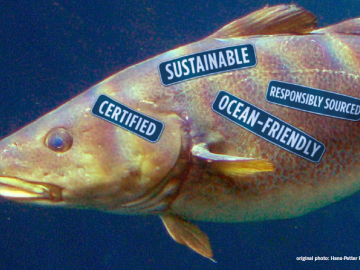
    “Sustainable”. “Ocean-friendly”. “Responsible”. From canned tuna to frozen fish sticks, these “green” claims seem to be slapped on every kind of seafood product in our grocery stores these days. But what do they mean? And better still, can we count on them to deliver on their promises? SeaChoice decided to find out. Spoiler alert: some are fishier than others. Read on to find out which.

    “Green” or environmental claims – logos and written statements – are supposed to help take the guesswork out of the selection process for shoppers who want to make ocean-friendly seafood purchases. When done right, claims represent a mechanism through which seafood consumers can ‘vote with their wallets’ and improve fishery and aquaculture practices by doing so. But greenwashing, the practice of making a misleading or unsubstantiated claim, can undermine this influence by fooling well-intentioned shoppers and shifting consumer preferences toward products that are not environmentally beneficial and/or creating an unwarranted favourable image of a company.

    We know that Canadians care about greenwashing. A YouGov poll conducted simultaneously with our investigation found that 83% of Canadians are concerned about greenwashing and 78% would likely stop purchasing a seafood product if its claim was found to be greenwashing.

    So, is there a warranted concern that greenwashing is taking place in Canadian supermarket fresh cases, aisles and freezers?

    In our study, Certification, Verification or Fabrication? an investigation of seafood environmental claims in Canadian retailers, released last week, we gathered data about environmental claims by going to 18 supermarket locations across five Canadian cities and provinces. Our sample consisted of 234 environmental claims across 181 seafood products.

    It’s important to understand that not all environmental claims are created equal. Some claims can be independent, such as third-party certifications (e.g., MSC, ASC and BAP) or non-governmental endorsements (e.g., Ocean Wise), or private company self-declarations. We categorized the claims into three types: certifications, endorsements, and self-declared claims. The different types of claims vary in their scope, accuracy, transparency and rigour. They also vary in their interpretation of “sustainability” as there are no regulations that strictly define the term for seafood (or any other commodity) sold in Canada. 

    First, we documented the prevalence of each environmental claim type and found self-declared claims – those made only by the brand, without any third-party backing – were the most common (44% of all claims). The rest were 33% endorsements and 23% certifications.

    Next, we checked whether the claims were backed up by publicly available evidence (i.e., the product label or website) and investigated whether the claim on the product could be verified to be from environmentally friendly fisheries or farms. Forty per cent of self-declarations failed to provide evidence and around six out of every ten self-declared claims were unverifiable. In comparison certifications, followed by endorsements, were found to be far more reliable.

    Finally, we compared self-declared claims against international best practice guidelines for environmental claims. Eight out of every ten self-declared claims were found to be vague and non-specific, over a third failed to provide an explanatory statement with the claim and nearly a quarter used the term “sustainable” (or a variation thereof) despite the recommendation by guidelines not to do so. 

    In summary, the most frequently found environmental claim type in Canadian supermarkets, self-declarations by companies, were the hardest to verify, typically lacked evidence and were often vague. Why would this be so? Self-declared claims rarely involve independent checks. In comparison, certifications generally have four common features: governance structures, standards for sustainability and chain-of-custody, an auditing function, and on-product logos. Self-declared claims typically lack the first three.

    SeaChoice is calling on the government to enact stronger requirements for self-declared claims, particularly for the use of the words “sustainable” and “responsible”, by stipulating that a third-party verification is the only acceptable evidence to support their use. Our investigation findings also support SeaChoice’s push for better seafood labelling laws, as having these would help substantiate the environmental credentials of a given product.

    What about conscientious shoppers just looking to buy some seafood for dinner that won’t harm the oceans? Based on our findings, your best bets are certified products, complementing these with endorsed products as needed. Regardless of the claim type, but particularly when purchasing self-declared products, look for evidence to back up the claim on the product or website. In fact, 90% of you agree that companies should provide publicly available information to back up their claims. So, tell your retailer and the seafood companies whose products  are sold within their stores that you expect this evidence to be provided.

    Lastly, If a product with an environmental claim lacks evidence to back it up, or if you suspect the claim may be a deceptive representation of the product (i.e., greenwashing), contact the Canadian Food Inspection Agency to report a food labelling concern.  Because at the end of the day, fishy claims shouldn’t have a place in our grocery aisles and freezers.  

  • Losing species names along the seafood supply chain

    Losing species names along the seafood supply chain

    Devoid of proper systems for data collection and retention, species information on a seafood product often disappears without a trace.

    The COVID-19 pandemic is revealing much about our seafood supply chains, with the reduction in global trade and shut down of many food service operations highlighting its vulnerabilities. The crisis has also resulted in increased public awareness of the product purchased and where that food comes from, such as where the fish was caught or farmed and the route it took to end up at the grocery store.

    Due to the complexity of seafood supply chains, traceability has become an increasingly important tool to help track, retain, and communicate information about a seafood product to buyers. Industry and NGOs have reported an increase in awareness for the necessity of traceability in the face of the pandemic, and into the future, especially in the context of health and safety and managing supply chain risk. Currently, in Canada, we lack the proper traceability systems and labelling requirements to know enough information about a seafood product, meaning even if it was recorded at some point, the information is likely lost as it moves through the supply chain.

    Furthermore, our basic global trade systems do not allow even species level information (ie the scientific name) to be recorded. The scientific name of a fish or shellfish product is a critical piece of information on a label as the common names on labels are often generic and can represent many different species, reducing the ability for a buyer to make a sustainable, and responsible decision. The basic information that follows a seafood product as it is traded globally is through Harmonized System (HS) codes, which are 6-digit commodity codes for international trade. The codes provide identifying information about items for import/export. However, with only 52,000 codes to identify every commodity traded around the world, categories can be quite broad. For example, there is a code for frozen fish fillets with no species attached. In Canada, HS codes are expanded by adding a Tariff Code, 4 more digits to further identify the commodity and the applicable tariff. However, there is still some broad categorization. As our Taking Stock report highlighted, a significant proportion of Canada’s fish and seafood is imported without a species associated with it, but rather in a variety of catch all categories that are identified as “not elsewhere specified” (NES) product, meaning that the product in question doesn’t fit well with one of the other HS codes. While some NES items do have a species association, many lack species identifications.

    HS Code Examples:

    Fish fillets, nes, fresh or chilled

    Fish stick & sim[ilar] prod[ucts],any size/sh[ape], fillets/o[r] portions,bread[ed]/coat[ed] w batter,exc[luding] minc[ed]

    It is clear that trade codes are not ideally suited for identifying species of fish and seafood, but rather for facilitating efficient international trade. This isn’t the only place along the supply chain where the species information is lost however. There are many places along the supply chain (especially in a globalized supply chain) where the species information may be lost. While the species of the catch is often recorded by harvesters on the boat, this information may be quickly discarded as it is required for fisheries managers, but not for the actual sale of the catch to the first buyer. Additionally, if the species information is passed on the processor, it can also be lost when several species are combined into a single product, when fish or shellfish from different fishing vessels or farmed are combined in a processing plant or simply new labels are placed on the product with new information. Finally, at the retailer or point of sale, the species information is rarely shared with the consumer, as Canada only requires the common name of the fish or shellfish on a product label.

    With so many chances for species information to be lost and the complex nature of our global supply chains, it is very difficult to trace back and determine the species of fish or shellfish. This creates a void of information that prohibits consumers from making informed seafood choices. Additionally, the sustainability of Canada’s imported seafood supply is not clearly under the mandate of any government agency, leading to a lack of responsibility for this data collection and retention.

    Without proper traceability systems species (and other important) information can be easily lost at each step along the supply chain if not required. Canada does not have food labelling or import regulations that require the recording of many important pieces of information, allowing it to get lost along the supply chain. However, the Federal government’s promise to implement a boat-to-plate traceability program is the perfect opportunity to fix this. It is time our government strengthened regulations for information collection, record keeping, and front of package labelling for seafood products to support seafood transparency.

    SeaChoice’s recent petition garnered over 5,600 signatures from engaged consumers who want to see proper seafood traceability implemented. Sign up for our newsletter to be kept informed about how you can support the government’s promise going forward.

  • Use it or lose it: seafood eco-certifications and stakeholder engagement

    Use it or lose it: seafood eco-certifications and stakeholder engagement

    NGO stakeholders are increasingly opting out of eco-certifications because their input disappears into the schemes’ “black box” of decision-making.

    Many seafood eco-certifications gain credibility due to the engagement opportunities they provide for stakeholders. Civil society organizations, alongside industry stakeholders, often play central roles in standard development and governance of eco-certifications. More often than not it is environmental and social justice non-governmental organizations (NGOs) that provide invaluable expertise and local knowledge by way of input to a fishery or farm certification. For example, that “certified sustainable” tuna in your pantry likely had an NGO help establish the sustainability criteria it met or, perhaps, register objections to its certification.

    In fact, stakeholder consultation is a fundamental component of any legitimate eco-label according to the frameworks that a number of seafood eco-certifications adhere to, including the United Nations Food and Agriculture Organisation (UN FAO) eco-labelling guidelines and the International Social and Environmental Accreditation and Labelling (ISEAL) codes of practice.

    Yet, despite these guidelines and codes, there is growing discontent by many NGO stakeholders who report fatigue, frustration and disillusionment with seafood eco-certifications. A number of NGO stakeholders have withdrawn or decreased their engagement with certifications citing little benefit to continuing their efforts. Some groups, including SeaChoice, have even initiated public campaigns in response, at least in part, to certain certification schemes’ inability to effectively address stakeholder concerns. The international Make Stewardship Count campaign is a good example.

    In light of these challenges, SeaChoice conducted an NGO stakeholder workshop during the 2019 Seafood Summit in Bangkok, Thailand, as well as an online survey, to explore stakeholder sentiment about participating in eco-certification processes, including any challenges and barriers, as well as what improvements scheme holders could make to help ensure meaningful stakeholder engagement.

    Read the full report here.

    Report Highlights

    Participants reported that eco-certification stakeholder processes were often not user-friendly,  requiring the need to “speak their language” (i.e., either referring to technical jargon or to documentation that is literally not available in their language) and that local and cultural contexts can be missed by auditors and certification processes.

    We heard that where stakeholders were able to engage in the process, stakeholders commonly experienced frustrations with the lack of accountability and transparency on how decisions are made. That is, stakeholder comments often appear to go into a “black box” of decision-making, and when the outcome is announced there is no rationale or explanation as to how input was considered, or not. Where responses were provided, stakeholders typically felt that they were not meaningful as they rarely adequately addressed stakeholder concerns.

    We also heard stakeholders express a general sentiment that stakeholder disillusionment is not taken seriously enough. In many cases, negative stakeholder feedback was met with hostile responses  by eco-certification schemes rather than serious engagement. This further eroded stakeholder trust and interest in program participation.

    Evidence suggests that stakeholder engagement can lead to higher quality decision-making and outputs. However, this is strongly reliant on the quality of the processes that lead to decision-making and other outputs. Done poorly, such processes can cause stakeholders to become cynical, harbour distrust and withdraw from the process. Such cynicism can, in turn, threaten the legitimacy of the decision-making. Based on the stakeholder perspectives represented in our report, we believe there is a cause for concern that seafood certification standard holders should make more efforts to incorporate stakeholders in decision-making, and be more transparent about their processes, in order to maintain legitimacy.

    Moreover, there is widespread agreement in the available literature that stakeholder participation hinges on the need for a genuine opportunity to be heard and to influence the decision. Therefore, for engagement to be genuine, certification standard holders should be open to stakeholder influence and ensure outcomes are not predetermined.

    Our report has been shared with the major seafood eco-certifications many of which are currently in the midst of important consultation processes (e.g. from MSC and ASC). We urge these schemes to strongly consider implementing the report recommendations as though their credibility and legitimacy depends on it. Because as stakeholder sentiment demonstrates – it does.


  • How are Canadian retailers really doing when it comes to seafood sustainability?

    Canada’s retailers have commitments to source sustainable seafood but often we have no idea if they are actually living up to them.

    Do you know what your retailer’s policy is on sourcing seafood? Every retailer has one, and these policies determine what steps, if any, the retailer is taking to make sure the seafood products it sells are environmentally sustainable and socially responsible – meaning that the people who produce them are getting fair wages and working conditions. Perhaps tellingly, not all retailers are transparent about how well they are living up to their policy and if they are actually sourcing products in line with their commitments.  

    SeaChoice designed Seafood Progress to help you find out. Seafood Progress looks at several aspects of transparency, from the general, such as “does the retailer have a publicly available commitment or policy to source more environmentally sustainable seafood?”, to the specific, such as “has the retailer published information about the fisheries/farms they source their products from?”. It assesses Canada’s largest seafood retailers on their commitments – what they say they are doing on seafood sustainability and what we know they are actually doing. This is because actions, not words, are the most important indicators of whether retailers are supporting good or bad environmental and social responsibility practices through their sourcing decisions. 

    Interestingly, all of Canada’s major retailers have made a public commitment to source more sustainable seafood; a consistency we didn’t see with any other commodities when we scrutinized the retailers’ websites. However, retailers’ environmental sustainability commitments vary considerably in their level of detail, use of credible external standards or seafood sustainability assessments, and reference to timelines for meeting their commitments. Even more variable were retailers’ commitments to source socially responsible seafood and their commitments to improve traceability of products in their seafood supply chains. With no publicly available information on either of these indicators and our requests for information unanswered, some retailers scored zero. 

    Out of all the major Canadian retailers, Seafood Progress reveals that only Buy-Low Foods, Federated Cooperatives Limited (“Co-op”), Loblaw, Safeway and Save-On Foods regularly publish information on how much of their procurement meets their commitment. That said, no Canadian retailers are currently disclosing which fisheries or farms they buy their seafood from – something that some British and American retailers have started doing either independently or through initiatives like the Ocean Disclosure Project 

    Many Canadians are concerned about the social implications of their seafood, for example whether it was caught by modern day slaves, but only some retailers are transparent about their actions to address this critical issue. Four retailers – Buy-Low Foods, Loblaw, METRO, and Save-On Foods – told us that their suppliers have all signed a Code of Conduct requiring them to uphold all aspects of the retailer’s commitments.  And only three retailers – Loblaw, METRO and Walmart Canada – have social responsibility commitments that reference international standards and include clear actions or expectations on their suppliers to do everything they can to ensure that human rights abuses play no part in their supply chain.  

    SeaChoice has followed up with every retailer profiled in Seafood Progress with recommendations for how they could improve their scores by working closer to best practice, and many of these recommendations are related to transparency. Transparency about what retailers are doing, or requiring their suppliers to do, is important so that you can be sure that you’ll be able to buy seafood long into the future, without compromising the rights and dignity of people who work to get it to your plate.  

    This year, Canada’s major seafood retailers scored an average of 37 out of a possible 100 on Seafood Progress’s transparency step; there is room for improvement. In early 2019, SeaChoice will be reaching out to retailers again to review their Seafood Progress profiles and see what has changed; we’ll update the profiles accordingly. We are hoping that retailers will score better when it comes to transparency around their procurement practices, especially in disclosing how their procurement is meeting their commitment and their social responsibility actions.  

    In the meantime, check out your retailers’ profiles and let them know you care about the transparency of their sustainable seafood actions.  There is a button on every retailer’s profile so that you can quickly and easily write a tweet to them that will help bring this message home.  

  • Holding eco-certifications ‘responsible’ to their claims

    Holding eco-certifications ‘responsible’ to their claims

    Over the last decade or so, you’ve likely noticed an increasing abundance of eco-labels at your local seafood counter. There are now over 30 different seafood eco-labels globally; many of which are for farmed seafood. But what do they mean? Are they really a guarantee of sustainability?

    Recently we discussed the notion that all farmed seafood is bad. Spoiler alert, it’s not. However, for some sectors of the aquaculture industry, exponential growth has led to environmental and social challenges. In response to these challenges, eco-labels for farmed seafood have proliferated – to the tune of $3.6 billion U.S. in 2015.

    Eco-certifications, when done right, can help drive important sustainability gains. This is why SeaChoice advocates for consumers and retailers to use credible eco-certifications to guide their seafood purchasing decisions. In addition to being able to demonstrate improved environmental performance of eco-certified producers, credible eco-certifications’ practices must be transparent and inclusive, with procedures that are fair, and criteria that are rigorous and upheld.

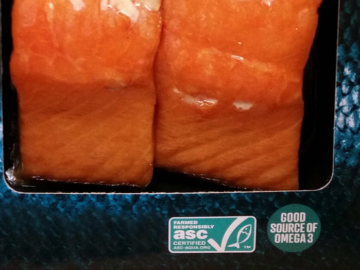
    One of the most prominent farmed seafood eco-certifications is the Aquaculture Stewardship Council’s (ASC) “responsibly farmed” eco-label. Established following a series of multi-stakeholder dialogues, which two SeaChoice member groups were a part of, the ASC Salmon Standard claims to define global best practices for managing environmental and social impacts. Today, 27 per cent of the salmon farming industry by volume and about 11 per cent of the total number of salmon farms certified feature the ASC eco-label.

    On a quest to understand how ASC certified salmon farms stack up, SeaChoice conducted a comprehensive global review of all audits (i.e. compliance assessments) filed for each of the 257 certified salmon farms – from the first farm certified in 2014 through to March 15, 2018. Our analysis included all major Atlantic salmon farming regions, including Australia, Canada, Chile, Norway and Scotland.

    Our review highlighted some good news. We found that most ASC certified farms were successful at meeting several key environmental indicators of the Salmon Standard such as fish feed ratios, chemical treatments, escapes and lethal incidents involving marine mammals.

    But it also uncovered some worrying trends, including that changes to the auditing processes and the Standard are eroding the best practices codified in the Standard. This means that consumers and retailers can’t tell exactly how ‘responsible’ the products with the ASC logo really are.

    For example, the Salmon Standard asserts that farms “must meet 100 per cent of the [Standard] requirements” in order to be certified. This is an impressive claim that instills trust in consumers interested in making environmentally and socially responsible food choices.  However, we found this claim to be misleading given the majority of ASC certified farms don’t actually follow the Standard as written. Take a deeper dive into the report analysis here.

    Where eco-certifications are seen as rewarding ‘business as usual’, the opportunity for potential and much needed sustainability gains within the industry are lost. This is why SeaChoice embarked on this global review – to determine if the ASC certification equals ‘best practice’ salmon farms. If not, what improvements should be made to ensure the rigour and credibility of the scheme are upheld?

    SeaChoice values the role that eco-certifications can play in improving the sustainability of fisheries and aquaculture. Our intent in carrying out this review, as well as our engagement with other eco-labels such as the MSC, is to recommend actions that eco-labels can take to address deficiencies, maintain the scheme’s credibility and, ultimately, have a positive impact ‘on the water’. In the end, we want to ensure that consumers and retailers buying seafood with these eco-labels are truly supporting industry best practices for sustainability.

  • A deeper dive into our ASC global report

    A deeper dive into our ASC global report

    In light of recent criticism, SeaChoice provides further information on our report , “Global Review of Aquaculture Stewardship Council’s Salmon Standard”.  The report provides the rationale and options for immediate and medium-term actions the ASC can take to reform key deficiencies and maintain or enhance the scheme’s credibility and its positive environmental and social impact. Our findings raise significant concerns for which, in turn, SeaChoice offers key recommendations.

    The Salmon Standard v.1.1 explicitly states, “Farms must meet 100 percent of the requirements in this document to achieve certification” 1.

    In order to assess whether ASC certified farms were in fact meeting this statement, we analyzed every audit from the first in 2014 to March 2018. We were able to review farm conformance and performance as certification progressed: from a farm’s initial audit to surveillance to recertification. In doing so, we were able to identify whether auditor reporting of farm-level metrics had improved (it has, mostly2), and whether farm conformance improved over time (it varied3). We additionally reviewed whether performance on Standard key indicators has changed over time. For example, SeaChoice examined farm’s forage fish dependency ratios – comparing Salmon Standard versions 1.0 and 1.1 feed requirements. We found certified farms have improved their fishmeal dependency ratios over time and that 95% of farms can easily meet version 1.1 Standard requirements, leading us to recommend that the ASC consider further reductions to reflect current best practices4.

    It is important to note that the Salmon Standard (and the other ASC standards) is supplemented with an auditor guidance document, known as the Certification Accreditation Requirements (CAR). SeaChoice’s review analyzed the CAR, as written and as operated, through the 456 audit reports. Our report found deficiencies with the CAR. For example certified farms in major non-conformance with the Standard have sold and are able to sell their product with the ASC logo5. This demonstrates the CAR’s suspension and withdrawal rules need strengthening.

    In addition, the ASC deploys a number of processes which affect the way in which the Standard and/or auditing processes (i.e. the CAR) operate. These include, variances (alterations to the Standard requirements at the request of auditors) and interpretations (ASC guidance to auditors). While these processes are deemed necessities for certification scheme operations, these processes in practice amend the Standard and/or CAR as written.  Some amendments were found to be undermining the organisation’s theory of change by eroding the best practices codified in the Standard.

    Critically, the variance request (VR) approval process lacks stakeholder engagement, as well as independent technical and scientific advice6. As International Social and Environmental Accreditation and Labeling (ISEAL) members, ASC follows defined codes of practices.  Section 6.4 of ISEAL’s Standard Setting Code states, “The standard is relevant in the local contexts where it is applied, based in part on input from local stakeholders”. To date, aside from the farm client (industry) themselves, no local stakeholders have been included in the VR process. We will continue to advocate for an inclusive and transparent VR process until such time as ASC has publicly moved toward stakeholder and technical inclusion.

    SeaChoice’s review also found some variances can enable farms that would otherwise be in major non-conformance with the Standard to be certified7.  ASC’s own accreditation body Accreditation Services International (ASI) warned ASC that such VRs substantially alter the intent of the Standard and are “probably putting at risk the program integrity”. They further recommended, “In case a VR changes the original intent of the Standard it is recommended that this should not be possible without public consultation and stakeholders review”.

    Our report also found ASC’s interpretations to be problematic. For example, an ASC interpretation allows auditors to omit intermediary stages from compliance8. Consequently, an ASC label does not guarantee the fish was “farmed responsibly” from egg to harvest. It also means an ASC-certified salmon in Australia or Canada (where interim farms are common) is not held to the same level of scrutiny as an ASC-certified salmon farmed in Chile or Norway.

    Furthermore, the ASC’s proposal for their Parasitcide Treatment Index (PTI)  operational review takes an approach that is more aligned with an aquaculture improvement project (AIP) model and not that of a ‘best practices’ certification9. The ASC PTI review proposes increasing the number of allowable sea lice treatments by up to 450 % in some countries (e.g. 11 sea lice treatments for Chilean farms) on the “condition” these farms eventually meet the ‘global target’ metric (i.e. 4 sea lice treatments). Yet our report found that 96% of farms can easily meet the current PTI threshold (2-3 sea lice treatments). To clarify, the ASC PTI proposal is not linked in any way to the ASC’s recently announced Improver Programme. However, on reflection, perhaps the PTI proposal would be more ideally suited for the Improver Programme.

    Eco-certifications, when done right, can help drive important sustainability gains. This is why SeaChoice advocates for consumers and retailers to use credible eco-certifications to guide their seafood purchasing decisions. In addition to being able to demonstrate improved environmental performance of eco-certified producers, credible eco-certifications’ practices must be transparent and inclusive, with procedures that are fair, and criteria that are rigorous and upheld. It is with that vision we provided ASC with recommendations that have the potential to strengthen the certification scheme in the long-term10. This in turn could help drive sustainability gains in the industry. Many of our recommendations are easily applicable to all ASC Standards as many stem from concerns systemic across the ASC scheme.

    SeaChoice member groups have been active stakeholders in the ASC and Salmon Aquaculture Dialogue for more than a decade. This has included steering committee representation during the original Aquaculture Dialogues, core participation in numerous ASC advisory and working groups, and active stakeholder engagement on ASC audits and projects. We will continue to work with the ASC, through various mechanisms, to ensure the intent of the Salmon Standard is upheld.

  • New SeaChoice report: What’s behind the label?

    New SeaChoice report: What’s behind the label?

    Click to download “What’s behind the label?”

    Our latest report reveals that seafood eco-certifications by two prominent organizations are falling short.

    What’s behind the label? Assessing the impact of MSC and ASC seafood certifications in Canada is the first review of whether the Marine Stewardship Council (MSC) and Aquaculture Stewardship Council (ASC) have improved sustainability in Canadian seafood production.

    With two-thirds of Canadian fisheries MSC-certified, and an industry goal to achieve ASC certification for all British Columbia farmed salmon by 2020, it is crucial these eco-labels are credibly applied and delivering genuine improvements.

    While both eco-certifications may have been on the cutting edge of best practice at their outset, our analysis suggests this is no longer the case. After a decade, the role of MSC to help push improvement forward in Canadian fisheries is increasingly limited with most Canadian fisheries now certified. After only two years in Canada, ASC is in danger of lowering its sustainability bar by deferring to government regulations that are below their Standard.

    It is essential that the Standards’ requirements of ‘sustainability’ are set high enough to reap adequate improvements to fishery and farming practice as they aim for certification. The schemes, otherwise, are only reinforcing status quo and, at worst, potentially undermining efforts to raise the bar higher. At risk is the credibility of eco-certifications, and ultimately, the health of marine ecosystems.

    SeaChoice is committed to working with both certification schemes on recommended improvements as well as with government regulatory agencies to ensure that Canada’s laws and policies for fisheries and aquaculture operations set a high bar for sustainability.

    More information:

    What’s behind the label? (page on SeaChoice website)

    Press release

    Download reports:

    What’s behind the label? Assessing the impact of MSC and ASC seafood certifications in Canada

    A decade of MSC certifications in Canada – technical report

    Aquaculture Stewardship Council (ASC) certifications in Canada – technical report