Category: Reports

  • US Federal Trade Commission urged to investigate BAP certification 

    US Federal Trade Commission urged to investigate BAP certification 

    A formal complaint submitted earlier this month, by Corporate Accountability Lab (CAL) and Southern Shrimp Alliance, to the US Federal Trade Commission alleges false or deceptive marketing by the Best Aquaculture Practices certification.

    You’ve likely seen the blue Best Aquaculture Practices label on farmed salmon and shrimp at the grocery store. BAP’s advertised claims include  “Ethical”, “Safe”, “Responsible”, and “Sustainable”. It is these claims that are at the centre of the FTC complaint – and for good reason.

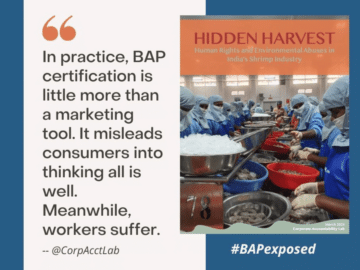
    Earlier this year, following a three-year investigation, CAL published shocking evidence of forced labor, child labor, unsafe working conditions, and other human rights abuses associated with BAP-certified Indian shrimp production process facilities. CAL also found evidence of BAP-certified shrimp farms polluting groundwater and farm land; as well as the use of prohibited antibiotics contained in BAP-certified shrimp.

    CAL and SSA’s complaint states that “despite the prevalence of these abuses, the BAP certification continues to be promoted as a trustworthy tool for consumers to ensure that they are buying environment- and worker-friendly farmed shrimp, in violation of the FTC Act”. They urge the FTC (Federal Trade Commission) to investigate and take action to enjoin BAP and Global Seafood Alliance (GSA), the trade association that operates the certification scheme, from making deceptive claims. 

    This is not the first time that BAP has been called out for fairwashing and greenwashing. This year the Outlaw Ocean Project also published evidence of BAP-certified shrimp associated with human rights abuses and banned antibiotics based on whistleblower testimony and evidence. In May, SeaChoice and 75 groups submitted an open letter to GSA denouncing the standard as greenwash as well as daylighting environmental damage, illegal activity, and/or negative impacts to endangered species associated with BAP-certified salmon farms. 

    Misleading claims by certifications unfortunately is not limited to BAP.  For example, fellow farmed seafood certification GLOBALGAP, was also included in a formal complaint submitted to the Australian Consumer and Competition Commission for endorsing salmon farms that are contributing to an extinction event (note – BAP was also listed in the complaint). The Marine Stewardship Council (MSC) certification has also been caught up in challenges over its claims; and a recent peer-reviewed study found human rights abuses are able to benefit from the use of the MSC label. 

    In our recent greenwashing submission to the Competition Bureau we highlighted the need for the Canadian Government to ensure all types of sustainability claims – including certifications – that are deemed misleading should be rigorously investigated.

    Given the evidence, major grocers and companies cannot simply rely exclusively on certifications to shield them from the risk of greenwashing; or as a guarantee to consumers for human rights and/or environmental harm-free seafood. Instead, given the limitations of certifications, companies must shift to implementing due diligence throughout their supply chains. Similarly, governments should adopt legislation that makes environmental and human rights due diligence mandatory for companies. You can tell the Canadian Government to adopt a due diligence law here. 

    To help drive change on the water, we invite you to subscribe to our newsletter.

  • Salmon Farm Transition 

    Salmon Farm Transition 

    It would appear that the government is serious about the transition away from open-net salmon farms. In a decision announced in mid-June, licenses for the remaining salmon farms were renewed for a period of five years, until 2029. Following that, they are “banned”. The long-awaited Transition Plan was unveiled only in September, along with a policy that clearly states that any new licenses for in-ocean or on-land salmon farms must employ “closed containment” technology. And there’s the rub: that technology doesn’t exist for in-ocean applications. We suspect that won’t stop the Department of Fisheries and Oceans from coming up with a definition of “closed containment” that allows semi-closed systems to be licensed.  

    It is entirely unclear that wild Pacific salmon could withstand the continued operation of farms that allow sewage, pathogens and parasites to enter their habitat; and that’s what semi-closed systems do. Those systems also rely on open-net pens to grow the fish for up to 12 months of the production cycle, so allowing them to be licensed would be transitioning from open-net pens…to open-net pens. 

    It’s also unclear how a government running a dismal 24% in national opinion polling is going to weather a 2025 election and stick around to give effect to their 2029 “ban”. They say there will be regulatory changes, but those have not been made public and may not be in place prior to the next election. 

    Equally troubling is the news that 9-year licences will be made available for industry if it chooses to use “closed containment” technology in the marine environment. Leaving aside the fact that the technology does not presently exist and assuming industry chooses to experiment to create it, the noise factor alone would make it unacceptable. The powerful pumps and generators that must operate 24/7 to keep the water circulating through a semi-closed system would render the marine environment inhospitable for any marine mammal and possibly for fish as well. 

    Longer licences would also be available for land-based closed containment. None of the companies operating ocean farms here has indicated the slightest interest in land-based aquaculture, although the parents of at least two of them have invested in it elsewhere in the world. If we aren’t transitioning the industry to land-based farms and in-ocean closed containment is beyond technological achievement by 2029, it would appear there’s only one choice for MOWI, Grieg and Cermaq: leave. 

    We have been urging the government to view the “Transition Plan” as a plan for workers and communities, especially First Nations communities that have enjoyed a revenue stream from royalties on the tenures in their territory for the past few years. The Task Force appointed to lead the whole-of-government approach to implementing the Transition Plan seems to be making serious effort to understand how best to stimulate alternative economic development opportunities and provide jobs and retraining for affected workers. We will continue to work with the Task Force to ensure that transition is achieved. 

  • Symposium on Canada’s global role in business and human rights

    Symposium on Canada’s global role in business and human rights

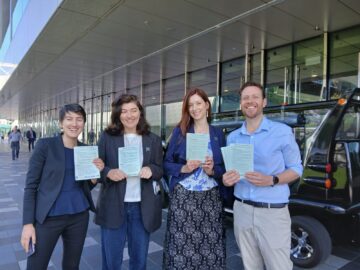
    SeaChoice’s Dana Cleaveley and Christina Callegari recently attended a symposium in Ottawa around how Canada can build on the models pioneered by other states to hold companies to account for human rights abuse in their supply chains. 

    The event was co-sponsored by The Canadian Network on Corporate Accountability and Above Ground. Fruitful discussions were had on international developments relevant to Canada, drawing on the expertise of global leaders. Participants included representatives from government, academia, the legal profession, and business.

    While these discussions are a step in the right direction, the truth is, products tied to human rights abuses continue to be imported and sold in Canada. The Canadian government needs to hear from and be pressured by civil society to take action. 

    We invite you to join the 50,000+ individuals who have signed The Canadian Network on Corporate Accountability petition to the House of Commons of Canada to adopt human rights and environmental due diligence legislation!

  • SeaChoice calls for tough greenwashing rules 

    SeaChoice calls for tough greenwashing rules 

    Globally, and in Canada, greenwashing has increasingly become a prominent issue across many sectors, including seafood. That’s why, in June, many conservation groups welcomed new greenwashing amendments to Canada’s Competition Act that will require companies use an “adequate and proper test” or “internationally recognized methodology” to substantiate their claims. However, there was concern that these new requirements lacked specificity for companies and consumers alike. In response, the Competition Bureau recently held a public consultation to develop enforcement guidance. 

    In our SeaChoice submission to the Bureau, we drew on our 2020 investigation which assessed  the rigour of 234 seafood environmental claims across 181 seafood products sold in the Canadian retail marketplace. We emphasized that our investigation found misleading and unsubstantiated claims are present on seafood products sold by Canadian grocers, with the potential to undermine improvements truly aimed at sustainability – highlighting the need for clear robust guidance and enforcement by government authorities.

    The most commonly found environmental claims on seafood products are company self-declarations  (e.g. “sustainable” or “responsible” logos and statements but with no third- party verification). Our investigation found these self-declarations often lacked evidence to back  up their claims with only 35% verified as coming from environmentally friendly sources. The problem is likely exacerbated by the fact there are no Canadian regulations that define the term “sustainability”, or the like; meaning its interpretation is left to those who claim it. This ambiguity allows the potential for questionable claims to enter the market.  

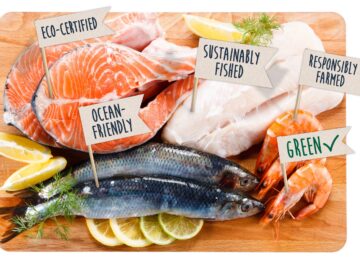
    Our submission also warns the Bureau that eco-certifications can also act as a means of greenwashing and/or misleading consumers with their promises. An example of this was the recent daylighting of evidence of environmental damage associated with the Best Aquaculture Practices certification in an open letter from more than 70 environmental, animal welfare, and community groups from 18 countries. The letter listed evidence of numerous BAP certified farms and facilities associated with ecosystem degradation, illegal activity, and/or negative impacts to endangered species. Examples were found in all major salmon farming regions: the U.S., Norway, Chile, Canada, Scotland, and Australia.

    Greenwashing doesn’t only occur on products at the store. It can be found at a company or sector-wide level as well. Companies often utilize a number of avenues and platforms to communicate and potentially embellish their environmental credentials, whether through online websites, social media, traditional advertisements, industry public relations talking points, and/or corporate sustainability reports. 

    The salmon farming industry provides numerous examples of misleading and uncredible claims. For example, the salmon industry often claims that ‘salmon aquaculture plays an important role in feeding the world’ and/or ‘eat a farmed fish, save wild fish’ (and the like). This misleading claim ignores the millions of tons of wild fish per year to feed carnivorous farmed salmon. A recent peer reviewed study found the industry is likely draining the ocean more than previously realized with new estimates of four or five kilograms of wild fish needed to produce one kilogram of farmed salmon. It also notes the industry’s hunger for wild fish takes fish from vulnerable coastal communities that rely on local fisheries for sustenance and/or income.  

    We call on the Competition Bureau to evaluate all potentially misleading claims, including eco-certifications. Our submission recommends that the onus is placed on companies marking the environmental claims to demonstrate that such claims are based on published, peer-reviewed and internationally recognized science-based evidence. Importantly, this evidence should be made publicly available and easily accessible for shoppers. 

    To stay informed and help drive change on the water, we invite you to subscribe to our newsletter.

  • Global first shareholder resolutions 

    Global first shareholder resolutions 

    This year we’ve been working with allies in Australia to initiate the world’s first shareholder resolutions to prevent an extinction emergency. Our expertise in farmed salmon, major grocer sustainable seafood policies, and aquaculture certifications informed the shareholder campaign, resolutions, and conversations with financial investors. 

    The resolutions call on Australia’s two major grocers, Woolworths and Coles, to disclose how their farmed salmon sourcing is impacting threatened species, and to stop selling Macquarie Harbour salmon due to impacts to the endangered Maugean skate – a shark-related species that has been around since the time of the dinosaurs. Only 40-120 adult skates remain in the harbour, it’s only home. 

    Some of Australia’s largest ethical funds have declared their support for the resolutions ahead of the grocers’ Annual General Meetings in October and November. At the AGMs tough questions will be asked of the companies’ boards and CEOs – including from our own SeaChoice representative from Living Oceans, Kelly Roebuck – as to how they can justify continuing to sell a product associated with greenwashing an extinction during a time when companies are expected to prevent biodiversity impacts throughout their supply chain, not contribute to them.

    By supporting the first global shareholder campaign of this kind, Living Oceans and SeaChoice is keen to see if a similar campaign could be established in Canada. Stay tuned!

    Help us drive change on the water by signing up for our newsletter.

  • Green Budget Coalition presents Budget 2025 recommendations to Finance Committee

    Green Budget Coalition presents Budget 2025 recommendations to Finance Committee

    The Green Budget Coalition, a group of 22 leading environmental organizations, released a comprehensive set of strategic recommendations for the 2025 federal budget to address the climate and biodiversity crises while reducing future costs and improving affordability and quality of life for people across Canada. SeaChoice organizations, Ecology Action Centre and David Suzuki Foundation developed fisheries and aquaculture specific recommendations and presented them to government officials in Ottawa, recently.

    The recommendations included asks for implementation of an ecosystem approach to fisheries management, building a modern fisheries catch monitoring and observer system, and ensuring the multi-million dollar growth opportunity of sustainable shellfish and seaweed farming. Proper fisheries management that considers the health and population dynamics of ocean ecosystems, effective monitoring and data collection and the growth of sustainable forms of aquaculture, are all critical for improving seafood sustainability in Canada. 

    For the detailed document, please see Recommendations for Budget 2025.

  • Tainted tuna “certified sustainable”

    Tainted tuna “certified sustainable”

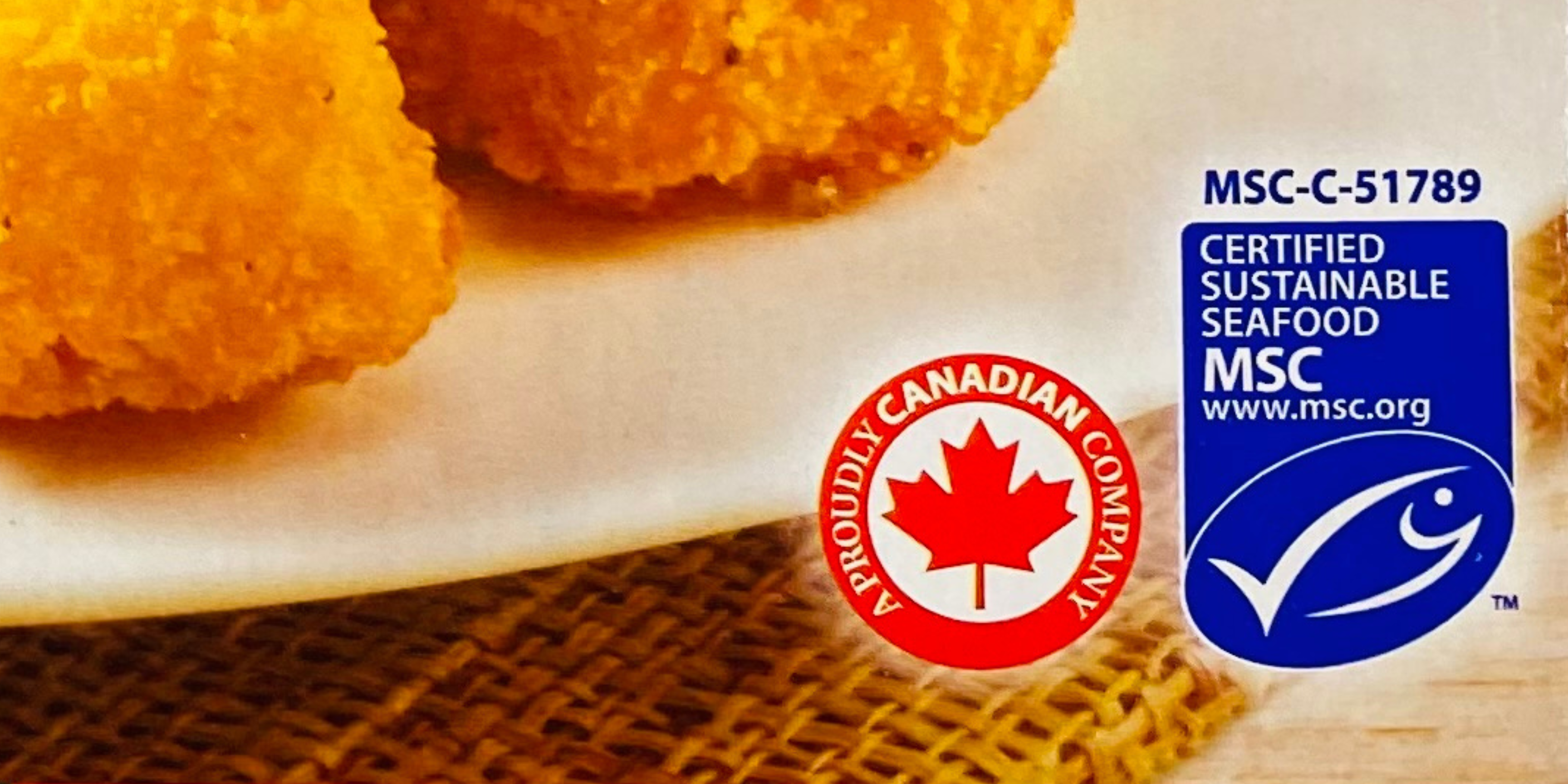
    A recent report by Katrina Nakamura of Sustainability Incubator reveals the Marine Stewardship Council (MSC) is neglecting to spot forced labor behind the tuna it stamps “certified sustainable.”

    Nakumara’s review of the standard shows the MSC doesn’t screen vessels or companies against published lists of labor abuses, meaning vessels found connected to egregious human rights abuses are able to benefit from the use of the world’s most recognizable ecolabel for sustainable seafood. Furthermore, Nakumara’s research reveals that 74% of the MSC’s certified tuna was not able to be traced back to the vessel or employer level.

    In response to this new research, Global Labor Justice (GLJ) issued a press release in which its Deputy director, Valery Alzaga, stated, “When consumers purchase MSC-labeled tuna, they reasonably expect that the product is free from human and labor rights abuses, but in fact, there are MSC-certified fisheries where the fishers are subjected to forced labor and unacceptable working conditions. The MSC only requires companies to submit self-declarations, allowing some of the largest seafood brands to ignore forced labor in their supply chains and avoid being accountable to fishers and their unions.”

    Disappointingly, in response to GLJ’s press release, the MSC dodged responsibility for the people behind the fisheries it certifies by reiterating that it “does not offer an assurance on forced or child labor.” Various NGOs in the sustainable seafood movement have voiced concerns around this stance for years. In response to a weak effort made in 2019 to address labor concerns under its revised Chain of Custody Certification, the MSC were called out for taking a low-bar approach that served as a poor model for other certification schemes looking to address seafood workers’ rights. 

    A recent campaign by SeaChoice demonstrated the importance of human sustainability to consumers, with nearly 5,000 letters sent to major retailers demanding they put a stop to egregious human rights abuses in their seafood supply.

    The campaign leveraged the disturbing findings of recent investigations conducted by The Outlaw Ocean Project and Corporate Accountability Lab. Collectively, these reports unveiled countless acts of inhumane working conditions, forced labor, child labor, severe abuse, neglect, murder, debt bondage, illegal and unregulated fishing, overfishing, and more. Unfortunately, these findings aren’t new, as human rights abuses have long been reported throughout global seafood supply chains. In fact, a recent report by the International Labor Organization revealed that annual profits from forced labor across sectors has increased by 37 per cent over the past decade. 

    One core demand outlined in SeaChoice’s letter to retailers is to stop relying exclusively on flawed certifications. Retailers need to do their due diligence by investigating their seafood supply chains, including those of the third-party products they sell. To affect change, certification schemes and retailers must stop passing the buck and take responsibility for the human rights abuses behind seafood.

    The MSC uses the claim “sustainable” on its label and specifies that it is meant to be interpreted in an environmental context. Where seafood is concerned, mounting evidence clearly demonstrates the interdependent linkage between environmental violations and human rights abuses. As such, the approach of certifications addressing environmental issues, only, is an outdated one. Other major certification schemes – including MSC’s counterparts, the Aquaculture Stewardship Council (ASC), and the Forest Stewardship Council (FSC) – have long addressed both environmental and human rights concerns. The MSC has an ethical obligation to ensure the products it labels as “certified sustainable” are not tainted by human rights abuses. 

    To join us in driving change on the water, we invite you to subscribe to our newsletter. 

  • Consumers demand retailer action in wake of exposés

    Consumers demand retailer action in wake of exposés

    Nearly 5000 consumers call on major retailers to stop human rights abuses in their seafood supply in response to reports connecting tainted seafood back to North American shelves. 

    In October of 2023, the first half of a four-part series by The Outlaw Ocean Project (Outlaw Ocean) was released, connecting severe human rights and environmental violations in China’s fishing and processing operations to seafood products on North American shelves. Several months later, investigations by Outlaw Ocean and Corporate Accountability Lab (CAL) uncovered serious allegations in the Indian shrimp supply chain – from hatcheries and shrimp farms to processing plants. Collectively, these reports unveiled countless acts of inhumane working conditions, forced labor, child labor, severe abuse, neglect, murder, debt bondage, illegal and unregulated fishing, and more. 

    In response to these findings, SeaChoice activated 4,795 consumers to send letters to the following retailers previously profiled on Seafood Progress: Buy-Low Foods, Costco, Metro, Save-On-Foods, Sobeys and Walmart. These letters called on retailers to take true responsibility for all the seafood they sell (not just their own brands), stop relying exclusively on certifications and audits, and take a due diligence approach to sourcing.

    The report series included a unique discussion page where correspondence – or lack thereof – between Outlaw Ocean and the companies found to be selling tainted seafood products was published. Some retailers – like Walmart and Costco – declined to respond at all, while others engaged and promised to investigate the allegations. 

    Astonishingly, nearly a year has passed since the first report in the Outlaw Ocean series was released, and none of these retailers have published updates around what they’re doing in response to the disturbing findings. 

    SeaChoice also reached out directly to the retailers to inform them of the campaign and offer guidance around next steps (read the letter here). Concerningly, only one retailer responded, and the oblivious nature of the message indicated they had not actually reviewed the report findings or supporting resources we had provided.

    To say this silence and oblivion is concerning would be an understatement. And it’s not just the corporate players that are stalling…

    The Canadian government has also failed to act in response to the report findings. 

    In a recent report, Outlaw Ocean stated that “while the U.S. has not imposed targeted sanctions as of yet, relevant authorities have begun the process of banning imports from companies tied to the investigation. The Canadian government has made no indication it will do the same. Human-rights advocates in Canada have said this silence and inaction from the Canadian government could create a potential backdoor through which imports rejected by the U.S. might re-route to Canada without issue.”

    In addition to the Outlaw Ocean reports drawing attention to the egregious human rights and environmental violations occurring in seafood production, it also highlighted the limitations and weaknesses of industry’s continued endorsement of and reliance on flawed voluntary systems, including eco-certifications. New research suggests “the Marine Stewardship Council (MSC), the world’s most recognized ecolabel for sustainable seafood…does not screen vessels or companies against publicized lists of labor abuses. These Standards leave room for vessels associated with crimes such as human trafficking and forced labor to benefit and profit from the MSC ecolabel.”

    This has resulted in key seafood supply chain actors – including major retailers and prominent certifications – being under increasing scrutiny from media, regulators, and civil society. 

    Meanwhile, human rights and sustainability due diligence within supply chains is gaining momentum, with the European Parliament having recently adopted mandatory legislation. This presents the opportunity to leverage the EU precedent to establish similar legislation in Canada and other jurisdictions. The Canadian Network on Corporate Accountability’s petition to the House of Commons of Canada to adopt human rights and environmental due diligence legislation inspires hope with over 50,000 signatures acquired so far. 

    The time for willful ignorance among major retailers is over. Shifting corporations to a due diligence business model to remedy human exploitations within their seafood supply chains will require the use of critical market and policy interventions to disrupt the voluntary infrastructure that they rely on and urge accountability for all the seafood they sell. 

    To join us in driving change on the water, subscribe to our newsletter.

  • Can DFO be trusted to implement the fish-farm ban?

    Can DFO be trusted to implement the fish-farm ban?

    Reposted from Hill Times

    Without being given legal force through legislation or regulations, the promised ban remains little more than another political promise vulnerable to ever-changing political winds.

    The majority of First Nations, commercial fishers, and concerned British Columbians heaved a sigh of relief when Fisheries Minister Diane Lebouthillier said Canada would “ban” open net-pen feedlots of Atlantic salmon in British Columbia. After fighting to protect wild salmon for 30 years, we may have finally achieved something here. It may not happen as quickly as we’d like to see given the perilous state of wild salmon, but we must applaud the politicians who have taken this brave step, and we must acknowledge the support that workers will need during this transition.

    But this initial relief comes with urgent, pressing, questions. How will the ban be given the force of law? And—more importantly—until then, how will endangered wild Pacific salmon be protected from the plume of pollution, parasites, and pathogens spewing from the open net-pen feedlots staining coastal British Columbia?

    Without being given legal force through legislation or regulations, the promised ban remains little more than another political promise vulnerable to ever-changing political winds. Our praise for that promise is coupled with healthy skepticism: the same folks now promising a ban by 2029 previously promised a “transition from” open net-pen feedlots by 2025. With at least one federal election between now and 2029, it’s possible those now promising a ban will not be around when the ban is supposed to take effect.

    A bigger mystery is how the Department of Fisheries and Oceans will protect wild salmon from polluting open net-pen feedlots for the next five years. The minister also announced that licences will be issued for five years, and promised “stricter” licence conditions and regulations, but provided no details. Those licence conditions, and more importantly their enforcement, will fall to DFO.

    It’s no secret that the public, and successive ministers have very different views than DFO bureaucrats on the harm open net-pen feedlots cause. DFO has consistently denied any connection between the pathogens and parasites flowing out of salmon farms, and wild salmon health. For years, DFO has refused to incorporate conditions of licence that measure or address sources of harm despite repeated and insistent calls from conservation groups and First Nations to do so. DFO still allows the stocking of open net-pen feedlots with fish infected with piscine orthoreovirus, and has not reviewed the efficacy of its sea lice management measures.

    Now, despite DFO’s denial, the minister has recognized the harm, exercised her discretion, and applied the precautionary principle by promising to remove this harmful industry from B.C. Her decision should be a fatal blow to DFO’s decades-long mismanagement by suppression and denial. Instead, we have an unresolved contradiction: on one hand, open net-pen feedlots must be removed to protect wild Pacific salmon; while on the other hand, those harmful feedlots can be governed by the ineffective regulatory regime and regulated by the same people whose objectivity and efficacy has been called into question by Justice Bruce Cohen, Canada’s chief science adviser, the commissioner for the environment and sustainable development, and the House Standing Committee on Fisheries and Oceans.

    Endangered wild Pacific salmon need decisive action such as the announced ban. They also need urgent change to how they are protected while we wait for that decision to take effect. Open net-pens in B.C. are being phased out because they threaten the survival of wild Pacific salmon. New licence conditions to address this threat should have already been collaboratively developed. Instead, they will be tacked on by DFO in five-year licences granted at the end of June. Rarely are conditions altered during the term of a licence, but that might be exactly what needs to happen to ensure we have any wild salmon left to protect when the promised ban takes effect.