Author: Kelly Roebuck

  • Shareholder activism X Sustainable seafood

    Shareholder activism X Sustainable seafood

    In a global first, a shareholder activism campaign targeting farmed salmon was launched this month in Australia. It’s a groundbreaking move that has the potential to shake up the sustainable seafood realm, worldwide, where the majority of efforts to date have centered around market-based incentives and large financial investors. 

    The Save the Skate campaign is aimed at Australia’s two largest supermarkets, Coles and Woolworths, calling on them to stop procuring farmed salmon from Macquarie Harbour farms that are considered a “catastrophic” threat to the endangered Maugean Skate. 

    Individual investors, unless they’re billionaires, typically lack influence over companies and their boards. But working together, small shareholders can have a big influence over the social and environmental practices of companies. SIX (Sustainable Investment Exchange) will rally more than 100 shareholders to drive forward the proposals, corporate engagement, and necessary interventions to achieve a positive outcome for the skate.

    Shareholder activism is a strategy of strength in numbers – and it works. 

    Need convincing? SIX lists some examples where shareholder activism has achieved big results:

    “In the last year Apple has agreed to report on union rights and Visa has promised to provide more details about its gender and racial pay disparities. A few years ago activist fund manager Engine no.1 installed 3 new board directors at Exxon despite holding only 0.02% of the company shares. Tulipshare was able to get a 44% vote for a resolution supporting factory worker rights at Amazon, even though its supporting shareholders held just $42,000 of shares in the USD$1.6 Trillion company.”

    The number of environmental, social, and corporate governance (ESG) shareholder activism campaigns have been on the rise in recent years. Most have centered around climate action and human rights. Some activism has begun around ocean plastic commitments, and past wins include Starbucks and McDonalds phasing out plastic straws. 

    But shareholder activism in the sustainable seafood space is new – and long overdue. 

    Back in 2022, Loblaw faced pressure from shareholders to publish supply chain audit records in light of concerns the company could be importing textile products with ties to Uyghur forced labor. While the motion did not pass, activist shareholders vowed to refile if the company and board failed to take appropriate action. 

    Late last year, Outlaw Ocean exposed a number of grocers (including Loblaw) and seafood brands with ties to Uyghur forced labor in Chinese seafood processing plants. Whether stakeholder activists in the publicly traded companies take up the cause remains to be seen.

    Fortunately, with the launch of the Save the Skate shareholder campaign, we are hopeful that a wave of similar actions to do with sustainable and socially responsible seafood will begin worldwide.

    The Save the Skate campaign is the first shareholder activism campaign to hold major companies to account for unsustainable seafood procurement. It is also likely the first shareholder activism centered around a species extinction emergency. Significantly, eco-certifications are also implicated within the campaign, as supermarkets rely on flawed farmed salmon certifications to sell Macquarie Harbour salmon as “responsible” to shoppers

    As part of our watchdogging of global farmed salmon certifications, SeaChoice member group Living Oceans has been leading the call for the BAP and GLOBALG.A.P. certifications to drop their endorsement of Macquarie Harbour farmed salmon. Living Oceans is also one of the collaborators of the SIX campaign. 
    Stay tuned to see what waves will be made in the shareholder activism X sustainable seafood space by subscribing to the SeaChoice newsletter.

  • ASC rejects harmful seal bombs 

    ASC rejects harmful seal bombs 

    SeaChoice’s watchdogging of ASC leads to global impact. 

    Recently, the Aquaculture Stewardship Council rejected a request from SCS Global, on behalf of their client Tassal (owned by Cooke Aquaculture), to allow them to continue using seal bombs (underwater explosives that can cause hearing damage and death to seals) on their Tasmanian certified salmon farms despite the ASC’s “zero” tolerance use of such acoustic deterrent devices. 

    The rejection is a result of SeaChoice’s watchdogging of the ASC – demonstrating that SeaChoice’s work has global impact. 

    Back in 2017, SeaChoice was the first to expose that the ASC’s variance request process was being utilized to weaken standard criteria behind closed doors. The flawed process enabled farms that would otherwise not meet ASC criteria to be certified. For example, British Columbia salmon farms were exempted from sea lice limits, while Chilean and Scottish farms were allowed to exceed chemical use limits. 

    Heeding SeaChoice’s calls to stop approving variances behind closed doors, in 2020 the ASC revised its process to include stakeholders and technical experts. 

    This meant the Tassal request was put through a technical review with a public consultation that allowed stakeholders to intervene. ASC’s rejection states Tassal did not provide “credible evidence for the risk of harm caused to seals”. Meanwhile, stakeholders provided credible evidence that seal bombs, underwater explosives, can cause injuries ranging from hearing damage to death.

    While the rejection was a ‘win’, the request did also unveil the limitations of certifications by way of auditors’ overreliance on evidence provided by companies. 

    Case in point: for nearly ten years the auditors failed to penalize Tassal, for their use of seal bombs (government documents show nearly 60,000 bombs have been used by the company, including on ASC farms, since January 2018). Audit reports dating back to 2014 reveal that auditors relied on written company declarations that Acoustic Deterrent Devices were not used on farms. Environmental groups are now calling on the auditor to suspend Tassal’s ASC farms. 

    You can learn more about SeaChoice’s watchdogging of certifications achievements in our five-year impact report.

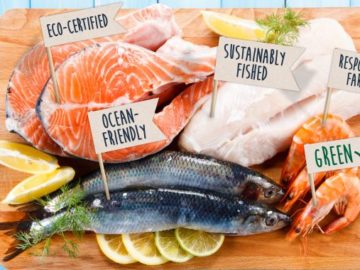
  • Avoiding the seafood greenwash this holiday season

    Avoiding the seafood greenwash this holiday season

    Whether you have salmon or the classic shrimp ring on your holiday shopping list – buying ‘green’ with confidence can be a challenge thanks to misleading claims.

    This year saw a wave of greenwashing challenges and human rights exposés in seafood markets across the globe. Many of which involved seafood certifications:

    For farmed seafood, the greenwashing of salmon farmed in open net pens continues to be called out worldwide. Earlier this year, SeaChoice led a global alliance of more than 80 groups calling for the Best Aquaculture Practices and GLOBALG.A.P. certifications to remove their endorsement of salmon farms that are contributing to the decline of the endangered Maugean skate. It was followed up with a formal complaint, regarding the product being sold to consumers as ‘responsibly sourced’, to the Australian Competition and Consumer Commission.

    A greenwashing complaint has also been filed in the U.K. over the Scottish farmed salmon industry’s claims of ‘sustainable’. It follows a review of farmed salmon certifications, including the Aquaculture Stewardship Council, in Scottish farms that found they failed to live up to their claims.

    It’s a familiar story in Canada: check out our guide on how farmed salmon certifications stack up.

    Wild seafood certifications have also been in the hot seat. In the USA, major seafood brands that utilize the Marine Stewardship Council certification are facing class-action lawsuits over their sustainability claims; and in Europe, a grocer was served a formal notice over their source of canned tuna which includes MSC certified fisheries.

    The shortcomings of certifications aren’t limited to environmental claims either. A recent investigation exposed the shortcomings of certifications in addressing human rights concerns. Shockingly, all seafood plants found to be using Uyghur forced labour from Xinjiang were certified by the MSC and ASC.

    While not all eco-certified seafood is greenwashing (some of it can be a good choice), the growing number of complaints and exposés highlights that consumers are all too often shopping in the dark – unaware of the limitations and/or omissions that can sometimes occur with eco-certifications and their associated claims. 

    It also suggests grocers and companies have become over reliant on certifications for meeting their seafood sustainability commitments. This over reliance can make companies vulnerable to criticisms and brand risk. It further highlights the need for grocers and companies to go beyond seafood certifications to ensure their claims are accurate and justified. Companies need to also ensure due diligence is taken to identify, prevent and take action when/if adverse impacts (e.g., slave labour, endangered species risk) occur within their supply chain. In other words, companies shouldn’t rely on certified products as a ‘get out of jail free card’ to avoid their own roles in greenwashing and due diligence.

    SeaChoice has been advocating for grocers and seafood brands to go beyond certifications.  Our Seafood Progress platform scores grocers and companies for taking meaningful actions to improve unsustainable seafood products – beyond simply sourcing certified seafood. We also score them on how accurate and credible their sustainability claims are. While some companies have made progress, much work remains. 

    So how can you try to avoid the greenwash these holidays? Consumer guides such as Ocean Wise are helpful. Choose unsung heroes that may not normally get the holiday love on our dinner plates – but are just as delicious and are inherently more sustainable such as farmed shellfish and seaweed. And for wild seafood, buy directly off your local fisher if you can (the Local Catch Network map can help).

    May your holidays – and seafood –  be truly green this season! 

  • Gift guide for Canadian seafood lovers

    Gift guide for Canadian seafood lovers

    Looking for a last minute gift that will speak oceans? SeaChoice has curated our top 10 picks for sustainable seafood lovers.

    Note: SeaChoice provides no endorsements of any products and companies. Rather, think of it as our staff’s wishlist 😉

    1, Keep it ocean-friendly with these seafood options

      From the west coast to the east coast, and in between, buying delicious and sustainable Canadian seafood is a definite winner for any holiday feast. Here are some examples:

      Holiday Menu Pack

      Photo credit: Organic Ocean

      2. Keep the oysters coming 

            Get shucking with this gorgeous oyster shucking board handmade by LittleMeadowsPEI.

            Photo credit: LittleMeadowsPEI

            3. Get by with a little kelp from your friends

            Kelp the planet, one bite at a time with this Kelp Blend popcorn seasoning by NAAS Foods – an Indigenous-led company based in Tofino. Kelping to make those holiday movies extra flavourful. 

            Popcorn Seasoning

            Photo credit: NAAS Foods

            4. Tis the sea-son with this seafood tea towel

            This tea towel by Claire Manning will bring a smile to any holiday dinner clean ups. 

            Photo credit: ClaireManning

            5. Books to read over the holidays

            • The New Fish: The Truth about Farmed Salmon and the Consequences We Can No Longer Ignore explores and exposes the salmon farming industry from the 1970s to today. 
            • Gumboot Guys: Nautical Adventures on British Columbia’s North Coast chronicles the first-hand stories of a generation of men who answered the call of the sea.
            • Kings Of Their Own Ocean: The marvelous tale of one fish, the fisherman who first caught her, and how our insatiable appetite for bluefin tuna turned a cottage industry into a massive global dilemma.
            The New Fish: The Truth about Farmed Salmon and the Consequences We Can No Longer Ignore image number 0

            Photo credit: Patagonia Books

            Photo credit: Caitlin Press

            Photo credit: Indigo

            6. And a book for the little ones

            Margaret Wise Brown’s The Little Fisherman tells a story of two fishermen – one little, one big – as they spend a day working at sea. 

            Photo credit: Islandport Press

            7. Spice up your holiday season

            Ocean flavours abound with this Bahama Mama spice from French-Canadian freediver and spearfisher, Valentine Thomas. 

            Photo credit: Valentine Thomas

            8. Don’t forget your (sea) veggies

            Harvested and dried in Nova Scotia, this ‘sea truffle’ (red algae) hits all the marks of fanciness and deliciousness. 

            Sea Truffle - Forbes Wild Foods

            Photo credit: Forbes wild foods

            9. Colouring in for the chefs in your life

            NEW Duo Umami Black Garlic & Miso image 1

            Miso, poke, sashimi? These Umami Duo Food Crayons are a must have for Japanese seafood lovers. 

            Photo credit: Umami Duo

            10. Bring the spirit of Salish Sea Salmon to holiday decorations

            Pay tribute to wild Pacific salmon with these handcrafted ornaments by Raven Wolden from the Sts’ailes First Nation.

            Salmon Ornament Set image 2

            Photo credit: CorvinaDesign

          1. SeaChoice’s Five-Year Impact Report

            SeaChoice’s Five-Year Impact Report

            As we approach nearly two decades of collaboration among SeaChoice member organizations, our new Five-Year Impact Report details how the program’s recent evolution has placed SeaChoice as an effective program with a global reach and impact. 

            Here are some of the report highlights:

            • Our work has led a dramatic shift toward transparency among major grocers and seafood brands, thanks to our unique Seafood Progress commitment tracking tool.
            • We enabled the conditions for two vital federal government commitments to be created: a boat-to-plate traceability mandate and a transition away from unsustainable open-net pen farmed salmon in British Columbia.
            • We have built and led global alliances to hold the world’s most prominent eco-certifications to account for greenwashing. Alliance pressure has resulted in meaningful improvements to scheme standards. 
            • Our advocacy has resulted in sustainability improvements at local, national and international fishery arenas. 

            Today, SeaChoice is poised to build on its watchdog role to further its place in the global sustainable seafood movement. 

            Read more about SeaChoice’s impact in the report. 

          2. Over 80 groups call out eco-certified extinction

            Over 80 groups call out eco-certified extinction

            SeaChoice leads global call to stop greenwashing extinction of prehistoric skate

            SeaChoice member groups have been holding seafood eco-certifications, such as the Marine and Aquaculture Stewardship Councils, to account for over 20 years. Our expertise has resulted in us leading global collaborations with other conservation organisations to call out the greenwash and demand certifications live up to their promises.

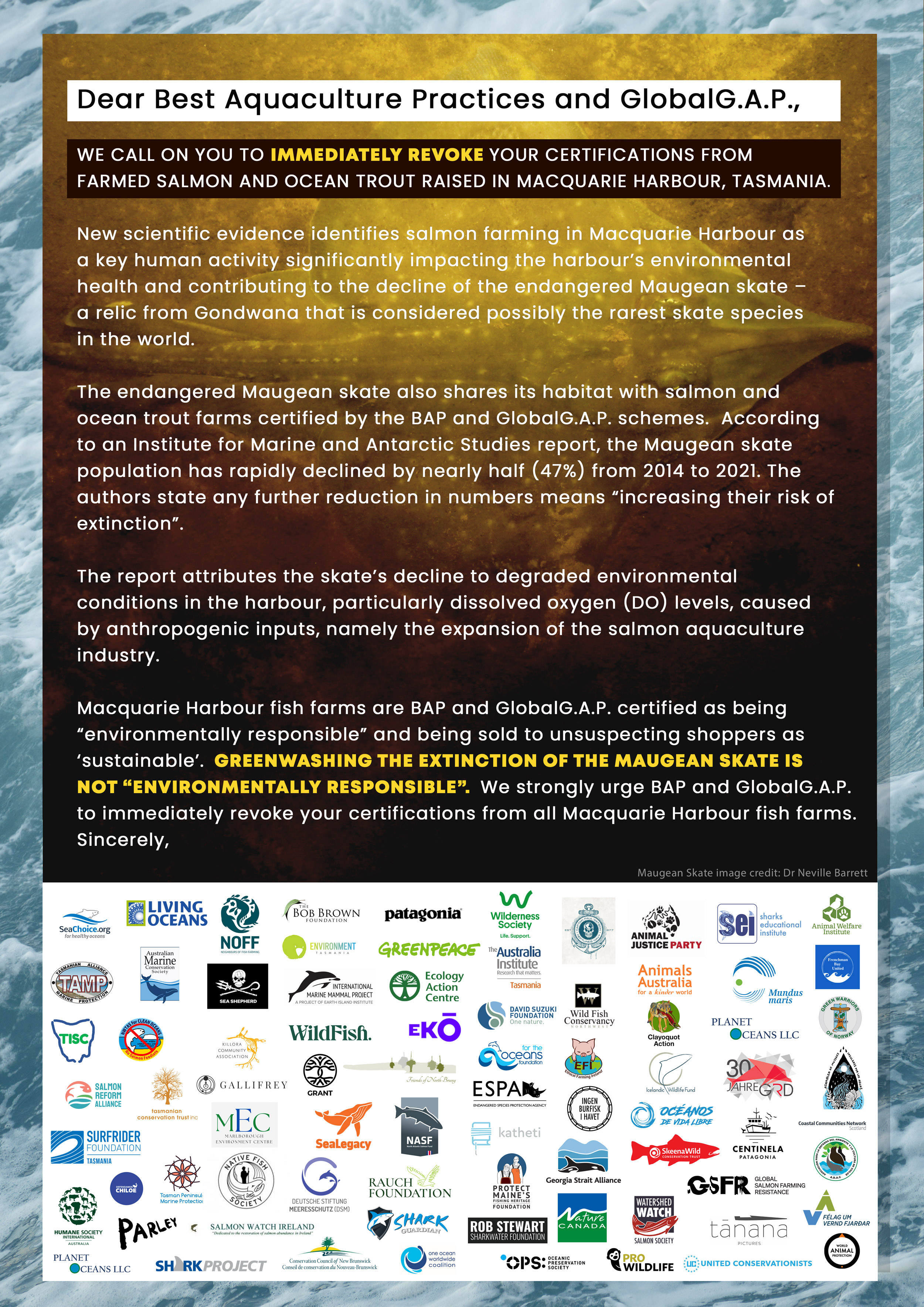
            Most recently, Living Oceans helped rally over 80 organisations from around the world calling on the Best Aquaculture Practices and GLOBALG.A.P. schemes to immediately revoke their ‘sustainability’ certifications from salmon and ocean trout farms adjacent to the World Heritage Area, Macquarie Harbour, on the west coast of Tasmania.

            Here’s the press release:

            MORE THAN 80 GROUPS WORLDWIDE DEMAND FARMED SALMON ACCREDITATIONS STOP GREENWASHING THE EXTINCTION OF THE MAUGEAN SKATE

            Shoppers being misled by eco-certifications on Macquarie Harbour farmed salmon

            For immediate release 25th July 2023

            More than 80 organisations from around the globe are calling for the accreditation schemes, Best Aquaculture Practices and GlobalG.A.P., to immediately revoke their ‘sustainability’ certifications from farmed salmon and trout raised in waters adjacent to the World Heritage Area, Macquarie Harbour, Tasmania.

            The demand comes as federal and state government workshops are held in Hobart this week to decide on urgent action to prevent the extinction of the Maugean skate – a rare animal related to sharks and dating back to the time of dinosaurs.

            Despite scientific evidence that industrial fish farms in Macquarie Harbour are having a major impact on the waterway’s health and skate numbers, all three salmon farming companies operating in the harbour are certified as “environmentally responsible” by BAP or GlobalG.A.P.

            Signatories from 17 countries have sent open letters to both schemes demanding withdrawal of certification, condemning the misleading of unsuspecting shoppers, and calling for an end to greenwashing the extinction of the prehistoric skate. 

            The signatories include marine, shark conservation, animal welfare, and community groups, as well as independent scientists, a public policy think tank, and award-winning authors.

            Found only in Macquarie Harbour, the endangered Maugean Skate is one of the listed natural values of the World Heritage Area.

            Scientists from the University of Tasmania’s Institute of Marine and Antarctic Studies renewed their alarm recently after reporting a dramatic collapse in Maugean skate numbers with almost half disappearing in less than seven years.

            The scientists attribute the Maugean skate’s decline to the degraded environmental conditions in the Harbour, particularly dissolved oxygen levels, and explicitly named fish farms as one of the main causes of low dissolved oxygen levels in Macquarie Harbour.

            Quotes:

            “Major supermarkets rely on these certifications to sell farmed salmon and ocean trout with their “responsibly sourced” logos as part of their sustainable seafood policies. But there is nothing responsible about driving one of the rarest skate species in the world to extinction.” – Kelly Roebuck, SeaChoice 

            “This is certified ecocide. The Maugean Skate has one critical habitat, one chance at survival, the science is there, and the urgent action that is required to save this animal is simply not happening. Instead, we have greenwashing.” – Jessica Coughlan, Neighbours of Fish Farms 

            “These certifications must not shirk their responsibility here.  They cannot palm this off to the auditors or wait until the companies’ next audit to address this dire situation. Macquarie Harbour fish farm certifications should be immediately revoked, or they will be the first certification schemes in the world to certify an extinction of a species.” – Alistair Allan, Bob Brown Foundation

            “Shoppers should be outraged to know that not only are they being misled by these certification claims, but they are unknowingly contributing to the demise of a species as old as the dinosaurs,” – Rebecca Howarth, Environment Tasmania

            “The federal government is in Hobart again this week because the Tasmanian Government cannot be trusted to prevent the extinction of this species. Meanwhile, so-called ‘sustainability’ certification continues to greenwash the unsustainable practices of the salmon industry.” – Eloise Carr, Tasmanian Director, the Australia Institute

            Media contacts:

            Kelly Roebuck, SeaChoice kroebuck@livingoceans.org 0432 660 064

            Backgrounder:

            Letter to Best Aquaculture Practices 

            Tassal (Cooke Aquaculture) and Petuna (Sealord) are BAP certified

            Letter to GlobalG.A.P. 

            Huon Aquaculture (JBS) is GlobalG.A.P. certified

            IMAS Interim Report: Macquarie Harbour Maugean skate population status and monitoring 

          3. B.C. salmon farms drop Aquaculture Stewardship Certification

            What does this mean for salmon sold in your local grocer?

            Back in 2020, salmon aquaculture giant Mowi Canada West (misleadingly) boasted that its B.C. salmon farms were 100 per cent certified to the so-called gold standard, Aquaculture Stewardship Certification. Fast forward to 2023 and Mowi, as well as Cermaq Canada, have dropped ASC like a hot potato. 

            So how did we get here and what does it mean for seafood shoppers?

            Mowi, previously known as Marine Harvest, had been an active steering committee participant in the dialogues organised by World Wildlife Fund that established the ASC’s Salmon Standard. SeaChoice member groups, David Suzuki Foundation and Living Oceans, also participated in the dialogues to drive the standard’s bar for certification as high as possible.

            The final standard, published in 2012, resulted in some ‘high bars’ – at least on paper – for sea lice and First Nations’ rights. The ASC seemed to be keeping their objective to certify only farms following best practice, defined as the top 15 per cent of the global industry. But that was soon to change. 

            Spoiler alert: the ASC now certifies around 50 per cent of the global salmon farming industry. 

            From 2012 to 2022, no B.C. farm should have been able to meet the 0.1 mature female sea lice per fish limit the Aquaculture Stewardship Certification required, yet the first ASC certification in Canada was awarded in 2016. It was Mowi’s Marsh Bay farm.

            So how was Mowi’s Marsh Bay certified – despite sea lice levels that peaked at 23 mature sea lice per fish? 

            Farm auditors applied for an exemption to the sea lice limit and ASC approved it. It gets worse: ASC ignored the direct consequences to wild salmon and expanded the exemption to all B.C. farms applying for certification.

            SeaChoice has called out numerous ASC certified farms with dangerously high lice loads over the years. These lice loads place wild salmon at risk and mislead consumers into thinking they are supporting sustainable farming practices. Most recently, we called out the Aquaculture Stewardship Certification’s revised sea lice criterion that dramatically increases (up to 1,550 per cent in some regions) the number of sea lice allowed on certified farms.

            Other ASC shenanigans include auditors certifying farms as being ‘socially responsible’ and in compliance with the “gold-standard’s” First Nations’ rights criterion. However, these certified farms are located in the unceded territories of First Nations who vehemently oppose salmon farms. 

            You might think that Mowi’s withdrawal from ASC isn’t so bad, given ASC’s track record of lowering the bar for farms to become certified. 

            But sadly, Mowi has simply replaced ASC with an even lower bar certification, Best Aquaculture Practices. 

            The BAP Salmon Farms standard requires little from farms beyond the industry’s norms. BAP has no limits on sea lice, disease, chemicals or sea lion deaths. 

            Another thing that Best Aquaculture Practices lacks is transparency. To the Aquaculture Stewardship Certification’s credit, they require farms to publish certain data on their website, including sea lice counts, in a timely manner. When Mowi shifted to BAP, they promptly stopped publishing counts. This limits the ability of the public, stakeholders and independent scientists to monitor (in as close to real time as possible during the juvenile wild salmon migration) what is happening on farms. Convenient, no?

            So, what does this all mean for seafood shoppers?

            No matter what faulty certification the salmon farmers use – all fail to protect wild salmon from disease and sea lice. 

            Summed up: while salmon farmers are switching from bad to worse certifications, they still remain on the ‘avoid’ list.

            SeaChoice recently assessed the farmed salmon policies of Canadian grocers and the major brands they sell. We found nearly all rely on ASC and/or BAP certification to sell open-net pen farmed salmon. 


            Tell your grocer these certifications don’t cut it and to stop selling open-net pen salmon on our Seafood Progress platform.

          4. Over 40 groups call ASC’s “farmed responsibly” label on salmon misleading

            Over 40 groups call ASC’s “farmed responsibly” label on salmon misleading

            ASC draft Farm Standard outrageously proposes to have industry audit themselves. 

            Recently, more than 40 civil society groups from across the globe joined forces in a letter submission to the Aquaculture Stewardship Council’s Farm Standard consultation calling out the certification scheme for misleading shoppers with their “farmed responsibly” label on open net pen farmed salmon. 

            The ASC’s “farmed responsibly” label features prominently on farmed salmon products in seafood cases of major supermarkets around the world. The label suggests to consumers that the product was “farmed responsibly” for its complete farming cycle. 

            However, in actuality, the ASC label does not guarantee an ASC certified salmon was “farmed responsibly” from hatchery to harvest.

            The truth is, a salmon product with the ASC logo on the package is likely to have met the ASC standard rules for only some of its production cycle: the hatchery and final growout farm stages. In fact, more than one-third of the salmon’s life is never assessed for environmental impact, such as sea lice outbreaks or chemical treatments.

            Currently, the interim stage of the production cycle is excluded from auditing and compliance with the ASC Salmon Standard.

            This is akin to saying an apple that was farmed using conventional non-organic methods for a significant portion of its growing season and organic methods for only some portion is still okay to label as “organic” on a supermarket shelf.

            SeaChoice first uncovered that auditors in British Columbia were omitting intermediary farms (initial grow-out sites that are used between the hatchery and final grow-out stage) from ASC compliance in our 2017 What’s Behind the Label report. Our subsequent 2018 Global Review of the ASC Salmon Standard confirmed the issue was also occurring elsewhere: transfers between non-certified and certified farms were observed in Australia, Canada, Chile, Norway and Scotland (although some more so than others). 

            The ASC responded with an interpretation for auditors that allowed them to continue to exclude the interim farm stage of production from audits. In effect, the ASC endorsed the loophole – despite acknowledging that the intent of those that established the Salmon Standard was to address the impacts associated with the complete production cycle. 

            The loophole has likely resulted in irresponsible farming practices that have gone unnoticed under the guise of ASC’s “farmed responsibly” label. In fact, we know this has been the case. 

            Case in point: ASC certified Hardwicke farm received fish that spent 14 months at the non-certified interim farm, Larsen, where the fish received 175.308 kg of Florfenicol antibiotics. Florfenicol is often used to treat Tenacibaculum maritimum aka mouth rot in Atlantic salmon. A recent study links farm-origin T. maritimum exposure and infection with potential negative consequences to Fraser River sockeye survival . Despite this, the ASC audit report for this production cycle of fish states zero antibiotics were used. 

            With their credibility at stake, it appears the ASC is finally taking note. The draft ASC Farm Standard proposes closing the loophole by requiring that the complete farming production cycle shall comply with the standard.

            But, it looks like they have been listening to the salmon farming industry too. 

            The draft ASC Farm Standard also proposes that the final grow-out farm applying for ASC certification takes responsibility for auditing their “suppliers” of the early production cycle stages for compliance against the standard.  As grow-out salmon farms are typically owned by the same company that also owns and operates the hatchery and early net pen sites, this will result in companies auditing themselves for ASC compliance for a substantial portion of the production cycle (from 12 to 30 months out of a 36~ month farmed salmon production cycle) – rather than a third-party accredited auditor.

            As the joint submission letter makes clear: any potential gains from closing the loophole will likely be undermined by ASC’s allowance for companies to essentially certify themselves.  

            According to ISEAL, an organization that defines Credibility Principles for sustainability standards for which ASC is a member, certification schemes should ensure that auditing processes are impartial and independent. 

            In other words, ‘the fox guarding the henhouse’ scenario has no place in sustainability claims. 

            As consumers, we place our trust in these promises. More than two-thirds of Canadian shoppers have checked for eco-labels, including certifications, when shopping. By preferentially choosing eco-labelled seafood products over ones without, shoppers place their trust in that eco-certification and its sustainability promise. 

            But consumers are also overwhelmingly concerned about greenwashing. The majority of shoppers would stop purchasing a seafood product if its claim was found to be greenwashing.

            Eco-labels, including the ASC, must live up to their promises or risk being seen as industry greenwash. The proposal to allow the industry to audit how “responsible” they are against the ASC Standard is not a credible solution. 

            SeaChoice and fellow signatories will be closely watching the next draft of the Farm Standard, due out for public consultation in September 2022, to see if ASC chooses credibility or industry greenwash. Stay tuned!

          5. Red rating confirms shoppers should avoid B.C. net-pen farmed salmon

            Red rating confirms shoppers should avoid B.C. net-pen farmed salmon

            Red rating challenges farmed salmon certification sustainability claims.

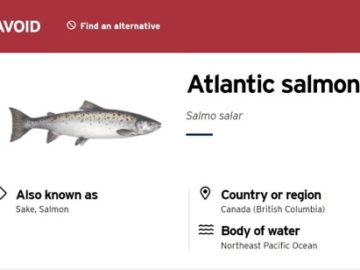
            In case you missed it, in December, B.C. farmed salmon was red-listed by U.S. seafood sustainability rating program, Seafood Watch (SFW). The downgrade confirms seafood shoppers should avoid buying B.C. open net-pen farmed salmon. 

            But it also raises questions about how these very same farms can be eco-certified as “farmed responsibly”, despite being red rated. So let’s break down the situation. 

            What earned B.C.’s industry a red rating?

            The SFW assessment acknowledges that sea lice outbreaks, fuelled by ineffective lice management and drug resistance, continue to plague farms and place juvenile wild salmon at risk. Meanwhile, rapidly developing research from the Strategic Salmon Health Initiative (and other groups) has highlighted concerns that bacterial and viral pathogens, which are released freely into the surrounding water by farms, could be leading to negative consequences to vulnerable wild salmon populations. 

            B.C.’s salmon farming industry also received a red rating because of its continued use of antibiotics listed as “highly important for human medicine” by the World Health Organization. On average, a B.C. salmon farm uses antibiotics 1.3 times a year. 

            What about those B.C. farms that are certified as “responsible” and “best practice”? 

            All active B.C. grow-out farms are certified by the Aquaculture Stewardship Council (ASC) and Best Aquaculture Practices (BAP). These are the same farms that produced the red rating. Yet even SFW, which assigned the red rating, recommends ASC-certified salmon as a “buy” option; but does not recommend BAP-certified salmon. Confusing, no?

            SeaChoice has serious concerns regarding SFW’s “buy” endorsement for ASC salmon. The recommendation is based on an out-of-date exercise from 2017, in which SFW assessed the ASC’s Salmon Standard against its own methodology and benchmarked ASC’s salmon certification as equivalent to its yellow or “good alternative” rating. However, the benchmark is based on an obsolete version of the ASC Standard (it has been updated twice since 2017) and fails to take into account ASC-approved changes to the Standard that substantially alter or exempt farms from critical environmental provisions. 

            Are any sustainability certifications living up to their claims?

            Aquaculture certifications and their associated labels make open net-pen farmed salmon appear sustainable. In actuality, these certifications are failing to protect wild salmon from disease and sea lice due to their loopholes and many “business as usual” criteria for farm certification. 

            That SFW used data from ASC-certified B.C. salmon farms to come to its red rating due to uncontrolled sea lice outbreaks is evidence of the fact that ASC certification is not protecting wild salmon.  ASC farms in B.C. have had sea lice counts over 20 mature lice per fish, while others had counts as high as 149 times the level ASC prescribes in its Standard. The farms were simply exempted from complying with this aspect of the Standard.

            Read more about how farmed salmon certified labels stack up in our infosheet on the topic – as part of our ‘Beyond Open Net-Pen Aquaculture’ briefing series. 

            Red rating comes at a pivotal moment for the industry

            Serendipitously, another related and significant development occurred in December – the Minister of Fisheries’ mandate letter re-committed the government to the following:

            “Continue to work with the province of British Columbia and Indigenous communities on a responsible plan to transition from open net-pen salmon farming in coastal British Columbia waters by 2025”

            This commitment has the potential to ensure the industry is actually observing “best practice” and its product is “responsibly farmed” – and not just certified with the claim to be so. The rating of B.C. farmed salmon as “avoid” due to its impacts on wild salmon reinforces the need to transition the industry from coastal waters to land-based recirculating closed systems. Such farming systems have earned a SFW green, or “best choice” rating. 

            So, should you buy B.C. farmed salmon, or not?

            Certifications that claim “best practice” or “farmed responsibly” don’t cut it when those practices are largely industry norms that continue to threaten wild salmon populations. Until such time that the B.C. salmon farming industry transitions to land-based, closed containment facilities, shoppers should continue to avoid open net-pen farmed salmon – certified or not.